

FOR IN-HOUSE LEGAL TEAMS
Adding more legal technology hasn't made legal easier to run.
There’s a reason. Legal departments have spent years solving operational problems one at a time, assembling separate systems for intake, contracts, matters, spend, collaboration, workflow and reporting. Each can improve the problem it addresses. Together, they create an increasingly complex operation that Legal has to coordinate, and that becomes almost impossible to keep in sync as the business continues to change.
The problem isn’t the technology. It’s the stack.
The Conventional Approach: Build the Stack.
Contract problem? Add CLM. Intake problem? Add intake software. Matter visibility? Add matter management. Reporting? Add analytics. Each decision can make sense on its own. But Legal does not operate as a collection of independent functions.
Every addition solves something. Every addition also creates something else to coordinate, maintain and adapt as the business changes.

The mot-r Approach: Manage the operation, not a collection of applications.
The mistake isn’t buying good technology. It’s trying to build an effective legal operation by assembling it from separate pieces.
mot-r takes the opposite approach. Start with one workflow or functional requirement and expand only as needed. Connect specialist systems where they add value. Replace fragmented operational tools where a simpler approach makes sense. Coordinate the people, processes, systems and AI involved in getting work done through one adaptable operating environment.
The stack manages the parts. The Legal Operating Layer manages the whole.
Why operational performance eventually plateaus.
Every new solution adds capability. It also adds another workflow, integration, data structure, interface and source of operational truth that has to remain aligned with everything around it.
As the stack grows, so does the synchronization burden. And the business does not stand still. Priorities change. Policies change. Teams change. Risks change. Systems change. Each change has to propagate across an increasingly fragmented operating environment.
That is how useful technology gradually creates operational drag. Workflows drift out of step with reality. Workarounds and bypass appear. Data becomes less trustworthy. The gains from each individual capability become harder to sustain.
As the business changes, the way Legal operates can gradually fall out of step with what the business actually needs. We call this drift. And the more fragmented the operating environment, the harder it becomes to keep everything aligned.
Capability increases
Every investment expands what the legal department is able to do.
Operational drag grows
Every new capability also increases the effort required to operate, maintain and adapt the department.
Drift
As the organization changes, the operating environment gradually falls out of alignment with how work is actually done.
Workarounds & bypass
When the operating model no longer fits reality, people naturally find other ways to get work done.
Untrustworthy performance data
Once work happens outside the operating model, performance data no longer reflects operational reality.
Performance plateaus
Management can no longer confidently measure, manage or continuously improve the department.
How does Legal know when it needs to change?
Drift is gradual, so it rarely announces itself. Legal needs reliable feedback from across the operation, not simply more system data: evidence that shows what is happening, where the operation is drifting and whether changes are working.
The Legal Operating Layer
Operational effectiveness requires one coordinated way of working.
Legal departments already have lawyers, specialists and technology. The problem is that those capabilities are commonly distributed across separate systems and processes that must continually be kept in sync.
The Legal Operating Layer provides an evidence-based management system for demand, priorities, capacity, workflows, decisions, risk, AI governance and continuous improvement.
It connects the systems worth keeping and provides operational capability directly where another point solution is unnecessary.
The result isn't another system to add to the stack. It's one coordinated way of running Legal.
A Legal Operating Layer
Reduces operational drag
Eliminates unnecessary administration and duplicate effort.
Continuously adapts as the organization changes
Revealing drift early so Legal can correct it.
Keeps work inside the operating model
Reducing workarounds and bypass.
Restores confidence in operational evidence
Reflecting how the department is actually operating.
Gives management the confidence to continuously improve
Based on evidence rather than assumptions.
A better-run operation is better for Legal and the business it serves.
Less operational burden means less avoidable rework, fewer unnecessary interruptions and less pressure on already stretched teams. Legal can provide better service to the business while spending more time on the work where its judgment creates the most value.
mot-r is your Legal Operating Layer.
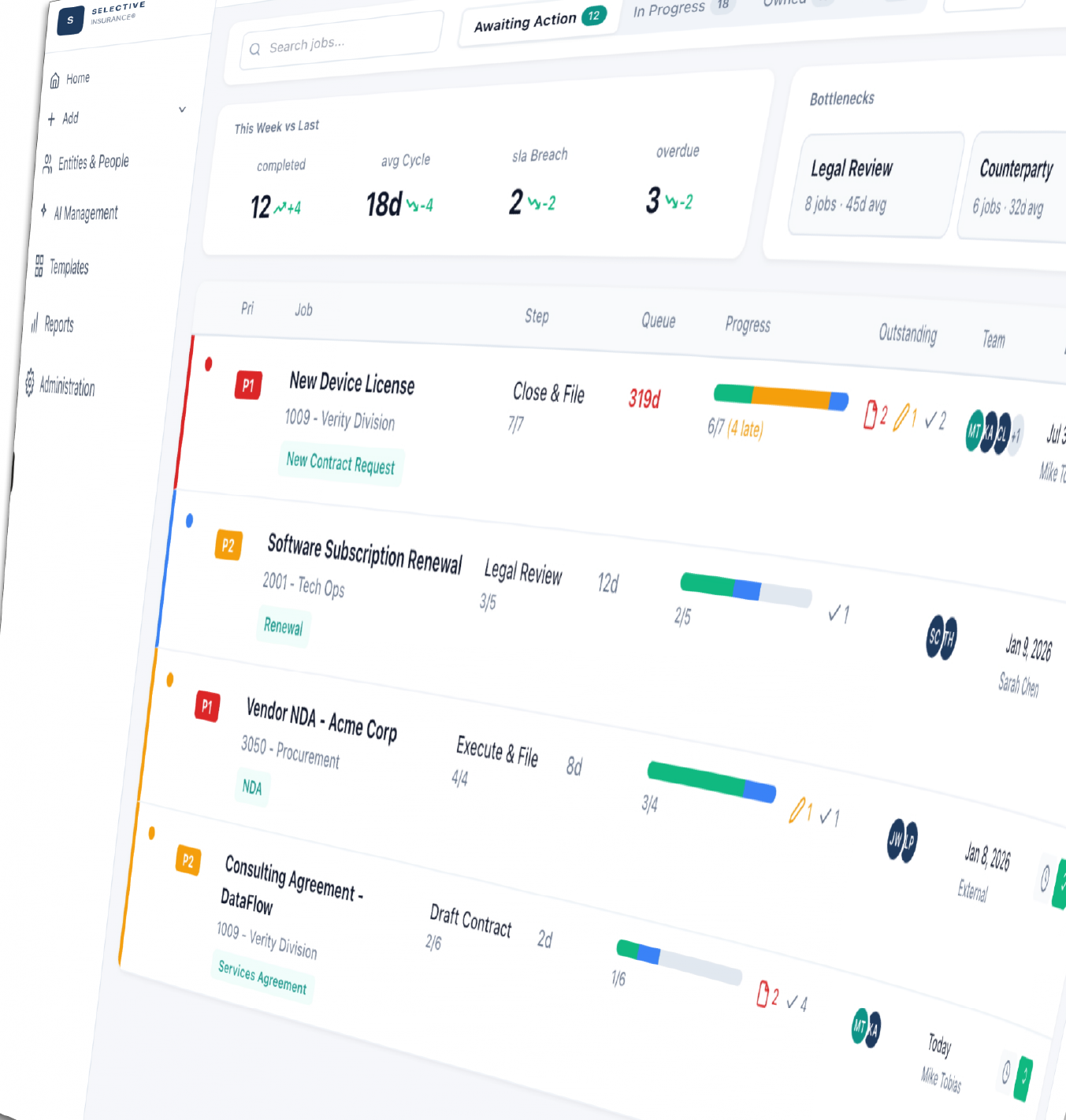
mot-r gives legal departments one coordinated operating environment for managing work across people, processes, systems and AI. It connects the technology worth keeping and replaces disconnected tools, workarounds and point solutions where a simpler approach makes more sense.
Efficiency matters, but it isn't the whole aim. The aim is to keep Legal aligned with what the business needs as those needs change.
The Work Creates the Evidence. The Design Lets Legal Act on It.
Useful evidence is more than activity data. In mot-r, decisions, responsibilities, approvals, risk and change are recorded as the work happens, in a form Legal can learn from. And because the Legal team can change how the work runs without another development project, it can act on what it learns.
The evidence needed to understand the operation is created by running it.
Work
What came in, what is in progress and how long each step takes.
Responsibility
Who owns each piece of work, and every hand-off along the way.
Decisions & Approvals
What was decided, by whom and under what authority.
Risk & Controls
The risks identified and the controls applied where the work happened.
AI
What AI accessed, what it did and where a person approved it.
Change
What changed, when it changed and what happened next.
Nothing has to be reconstructed after the fact.
Each improvement should make the next one easier.
- 1Start with one workflow
- 2Observe how it performs
- 3Learn from the evidence
- 4Decide what should change
- 5Act on it
- 6Measure what happens next
- 7Carry the learning into the next improvement
- ↺ Then the cycle begins again.
Every solved problem is a tool for the next one. As conditions change, Legal adapts the way it works without starting over.
The goal isn't simply to adapt to change. It's to become better because of it.
Prove it in 60 Days.
Choose one of your real workflows. We'll configure it with your people and processes and agree in advance how success will be measured: cycle time, work in progress, stale work and first response time. Judge the evidence before you make a broader commitment. Expand from there only if it makes sense.