

The mot-r Response
What each operating mode demands, and how mot-r meets it.
Five Modes, One Platform
The companion reference describes five operating modes running at once across the whole work surface and names the issue worth tackling first in each. This document answers the next question: what each mode demands of the operating model, and how mot-r meets it.
The starting point is the trap most legal technology is sold into. A platform is shown performing one mode well, usually Business As Usual, and bought on that demonstration, and its limits in the other four surface after deployment, once the team depends on it and the cost of switching is high. The five modes run concurrently, so a tool that meets one and leaves the others to improvisation fails exactly when the department is under the most pressure.
Business as Usual
Eliminating administrative waste so attorneys focus on legal judgment rather than manual status tracking.
Emergency Room
Ensuring rapid mobilization and information coherence when high-stakes crises arrive without warning.
Looking for Icebergs
Scanning internal signals and operational evidence to identify strategic risks before they become crises.
Change & Adaptation
Adjusting workflows, approvals and responsibilities when reorganizations, new policies or new business change how Legal has to work.
Learning & Improvement
Closing the loop by turning operational evidence into institutional knowledge and better processes.
One Layer Built, One Layer Supported
mot-r works in one layer and supports the other. The Practice Layer is the legal expertise itself: reading a regulatory shift, drafting the hard clause, negotiating the deal, judging enterprise risk. The Operational Layer is the delivery system around that work: how requests arrive, get triaged, routed, tracked, managed, and reported, and how the department itself is run and improved. mot-r is built for the Operational Layer.
The legal work
- Focus
- Legal judgment on matters, risk and advice
- Examples
- Reading a regulatory shift, drafting the hard clause, negotiating the deal, judging enterprise risk
- Evidence used
- Facts, documents, precedent and rules
How Legal runs
- Focus
- How work moves, who owns it and how the department runs
- Examples
- How requests arrive, get triaged, routed, tracked, managed and reported, and how the department improves
- Evidence used
- The operational record, created as the work happens
mot-r has two modules. mot-r Q structures the work at the point of entry, and mot-r Ops runs everything that follows. The principle underneath both is that the operational evidence a department needs to see itself is created as a byproduct of doing the work, so the operating picture stays whole and current without a separate reporting exercise that competes with legal work for time.
The sections that follow take each mode, state what it demands, show how mot-r meets it, and mark where the alternatives stop short.
How mot-r Meets Each Mode
Business As Usual
Effectiveness, efficiency, and the systematic elimination of work that should not exist
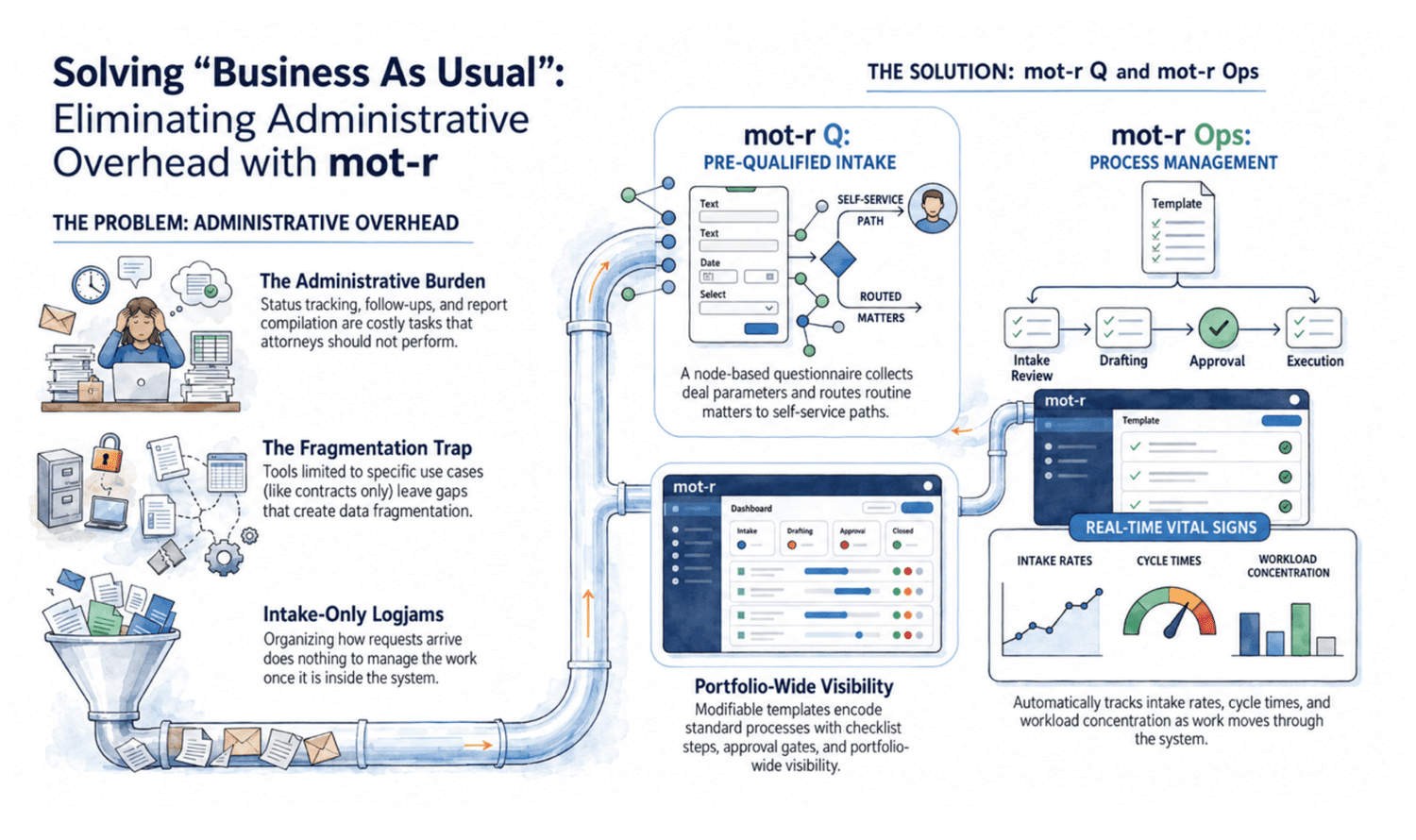
Business As Usual is the chronic pressure: high volume, unpredictable sequence, and concrete consequences when work falls through the cracks. The objective has two parts most departments hold separately: delivering legal service reliably and continuously reducing the work that should not reach attorneys at all.
The largest and most damaging part of that second job is the administrative overhead accumulated around legal delivery: status tracking, follow-up, spreadsheet upkeep, and report compilation. Attorneys doing that work is a design failure, more common and more costly than the low-complexity legal work most vendors address, and it stays in place because conscientious people absorb it until they cannot.
mot-r Q is the intake layer. A node-based questionnaire collects deal parameters, counterparty type, value, and risk factors at submission, so routine matters route to a self-service or simplified path and the work that needs a lawyer arrives pre-qualified and with full context.
mot-r Ops runs what follows: modifiable templates that encode the standard process for each work type, with checklist steps and approval gates, and a Work in Progress view of the entire active portfolio across every work type, so a building concentration of load shows up before it produces a missed deadline or a resignation.
The vital signs that govern the mode (intake rate, cycle time, work in process by practice area, and stale or overdue work) are created as the work moves. When the business changes, Legal Ops modifies the templates directly, with no vendor services or IT lead time.
Most tools sold into this mode cover only a strip of it. A contract lifecycle product runs contracts; a matter management product runs matters. Intake-only solutions structure the front door and create a logjam of work with nowhere to go. A billing or spend platform sits further from the problem again, built around the invoice, so the administrative overhead never reaches it.
One operational layer that moves any work type from entry through close and shows the whole portfolio while it does.
Emergency Room
Concentrated response to serious, time-sensitive problems in the business
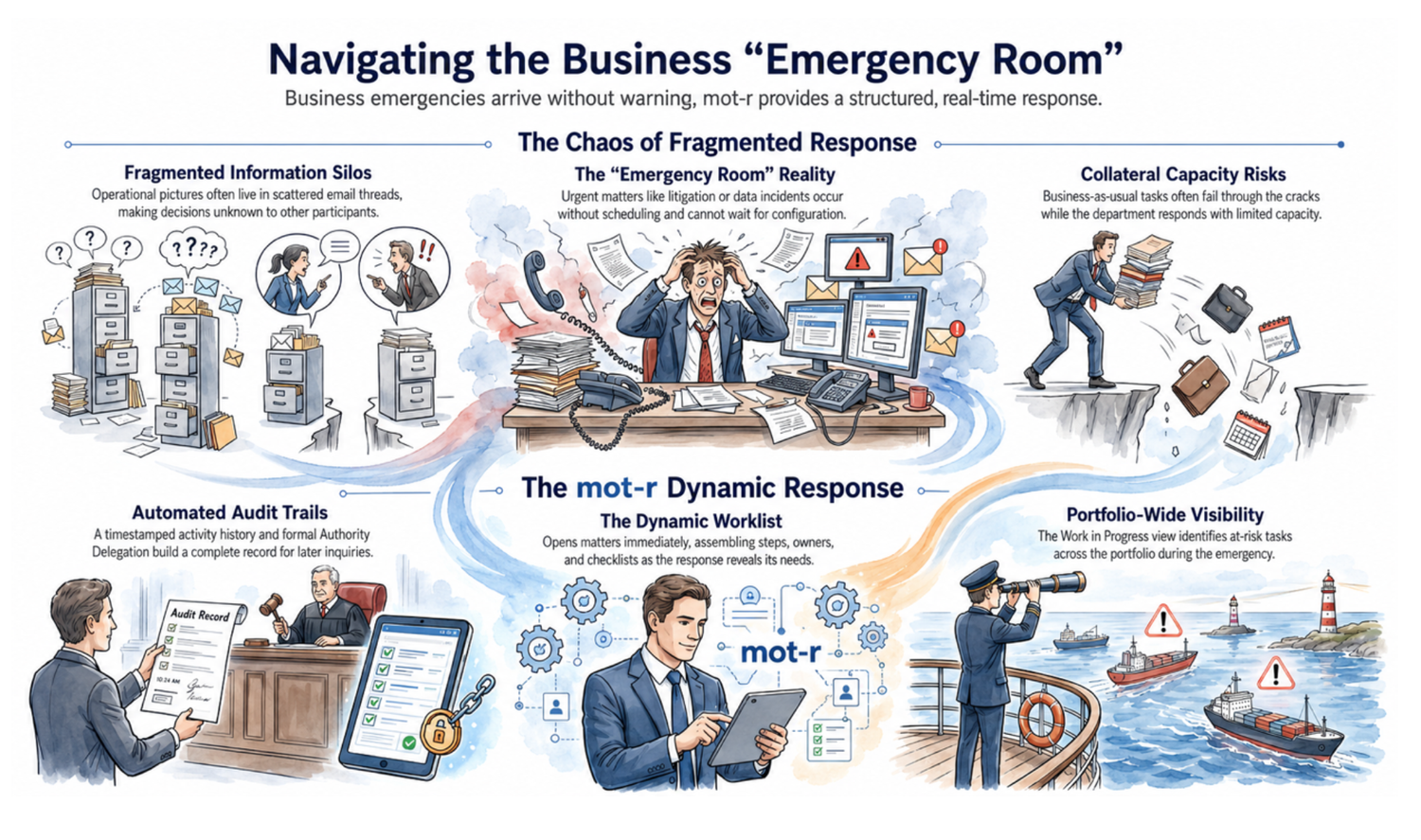
Emergency Room situations arrive without scheduling and cannot wait for process design: a regulatory inquiry, threatened litigation, a data incident, an M&A timeline that compresses overnight. The department responds with whatever capacity it has, and Business As Usual does not stop while it does.
The response is only as good as who happens to be available, because the operational picture lives in people's heads and scattered email threads, and decisions made in one thread are unknown in another.
Most workflow platforms need a template before a matter can be managed, and an emergency does not wait for configuration. mot-r's Dynamic Worklist opens a matter immediately and assembles its structure (the steps, owners, checklists, document requirements, and approval gates) as the response reveals what it needs, with every participant seeing the same record from the moment they join.
The full platform stack travels with it: checklists enforce completion, approvals hold under pressure, and a timestamped activity history builds the complete record as the work happens, so it does not have to be reconstructed afterward.
Authority Delegation creates a formal, time-bounded, auditable record of who was authorized to act, which is part of the department's protection in any later inquiry. The same Work in Progress view shows what is now at risk across the rest of the portfolio, so capacity is redistributed by deliberate decision while the emergency is live.
Emergency response assembled out of separate tools fragments the operating picture at the one moment a shared picture matters most. Email-based response produces parallel threads, decisions no one else can see, and a record that has to be rebuilt from memory when the inquiry comes.
A single operational record from the first moment, so the department can coordinate under pressure and preserve the evidence of what happened.
Looking for Icebergs
Continuous horizon scanning for emerging risk before it becomes crisis
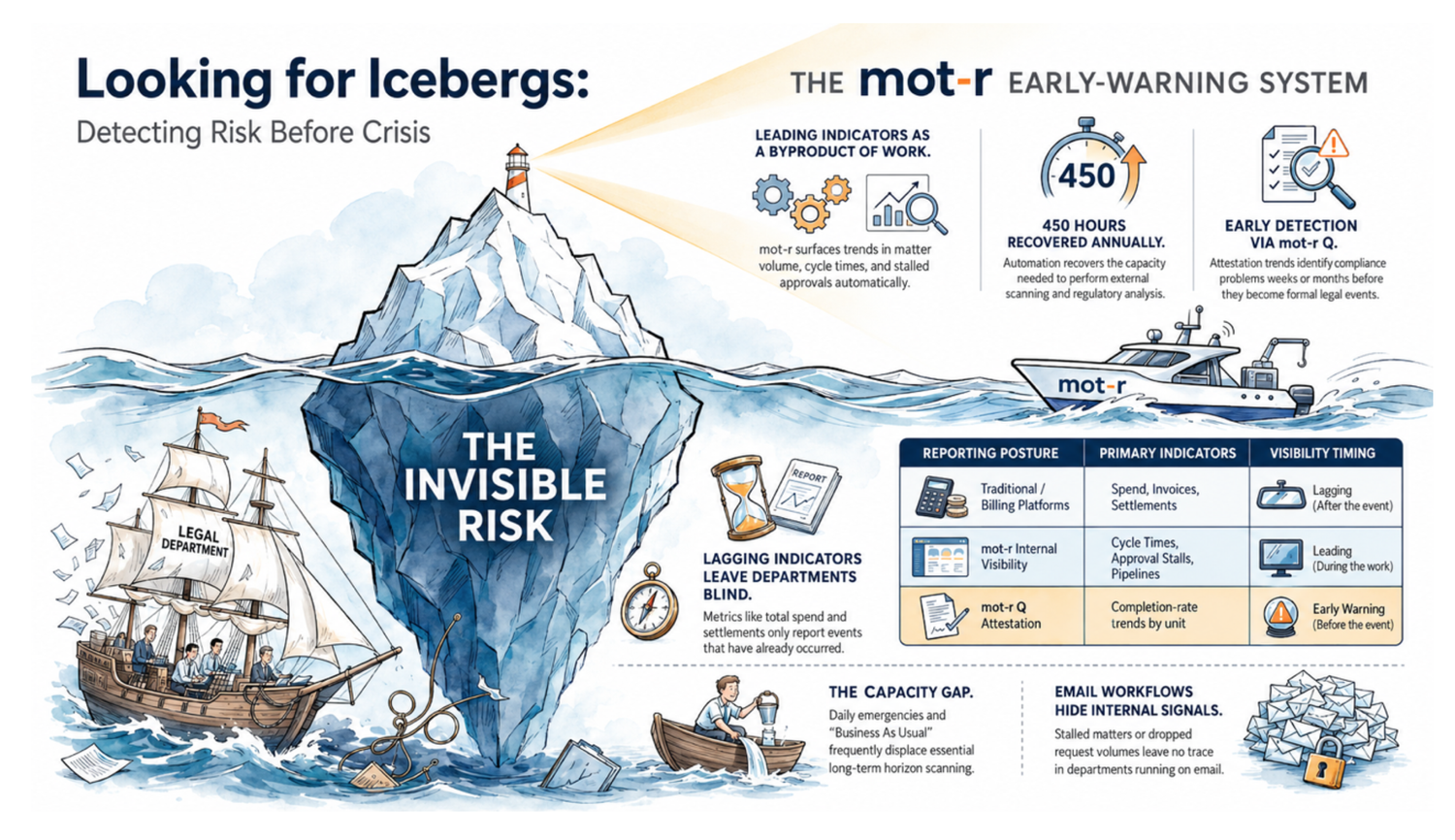
Looking for Icebergs is the forward scan for signals, inside the organization and outside it, that will need a legal response before they escalate. The failure here is capacity. Most departments understand what horizon scanning requires; what they lack is the time to do it consistently.
The internal signals are where most of this stops short. A business unit whose request volume has dropped may have stopped asking and started routing around legal; a matter parked at one step for weeks is unaddressed risk; an approver who consistently delays is a governance gap.
Those patterns live in the operational record, in the departments that create a structured one. In departments running on email, the same patterns leave no trace. The departments that report only lagging numbers to the board (total spend, contracts executed, settlements) have no early-warning capability at all.
mot-r's contribution here is internal signal visibility, created as a byproduct of normal operation. The reporting layer surfaces period-over-period trends in matter volume, work-type distribution, cycle times, and practice-area patterns; the approvals reporting shows who is approving, how long it takes, and where it stalls; the pipeline view shows where work is concentrating and where it has stalled.
The attestation analytics in mot-r Q extend the view into the business, where completion-rate trends by unit are often the earliest visible evidence of a developing compliance problem, weeks or months before it becomes a formal legal event.
External scanning of regulatory pipelines and counterparty behavior takes capacity and standing, and the roughly 450 hours a year that operational automation recovers in Business As Usual are what make that work structurally affordable, while the credibility of running well is what earns legal early access to the decisions that create exposure.
Billing and spend platforms are built around the lagging indicator. mot-r creates the leading indicators because they fall out of running the work, so the early signal exists in structured form before the resignation letter or the board inquiry.
Structured operational signals that reveal developing risk before it becomes a formal legal event.
Change and Adaptation
Reorganizations, new policies, new business, and the drift they leave behind
Change and Adaptation is episodic and unavoidable. A reorganization moves responsibilities, an acquisition brings new entities and contracts, a new regulation adds an approval step, a new leader changes priorities. Each one changes what Legal needs to do, usually on the business's timeline rather than Legal's.
The failure here is speed. Each change lands on an operating model built for the business as it used to be. Approval rules, responsibilities, and workflows fall gradually out of step with what the business now needs. That gap is drift, and it rarely announces itself. It shows up as workarounds, exceptions, and work quietly routed around the system.
Most platforms make adaptation a project. The system was configured once, by the vendor or by IT, so every reorganization or new approval rule becomes a change order, a services engagement, or a place in someone else's queue. While the change waits, the workarounds become the real process.
In mot-r, Legal Ops makes the change directly. Templates, approval gates, routing rules, and responsibilities are modified by the people who run the work, with no vendor services or IT lead time. Authority Delegation records who is authorized to act as roles move, and the operational history carries forward through the change, so nothing about how the department worked before is lost.
Change also reaches the technology underneath. mot-r runs across more than one document management system and works with the AI providers a department chooses, so replacing a document system or switching AI models does not mean rebuilding the way Legal works.
Because the work keeps creating evidence, the department can see whether a change actually worked: whether cycle times recovered, whether exceptions dropped, and whether the new path is the one people actually use.
An operating model the department can change as fast as the business does, with evidence showing whether each change worked.
Learning and Improvement
Closing the feedback loop: process refinement, stakeholder intelligence, and operational maturity
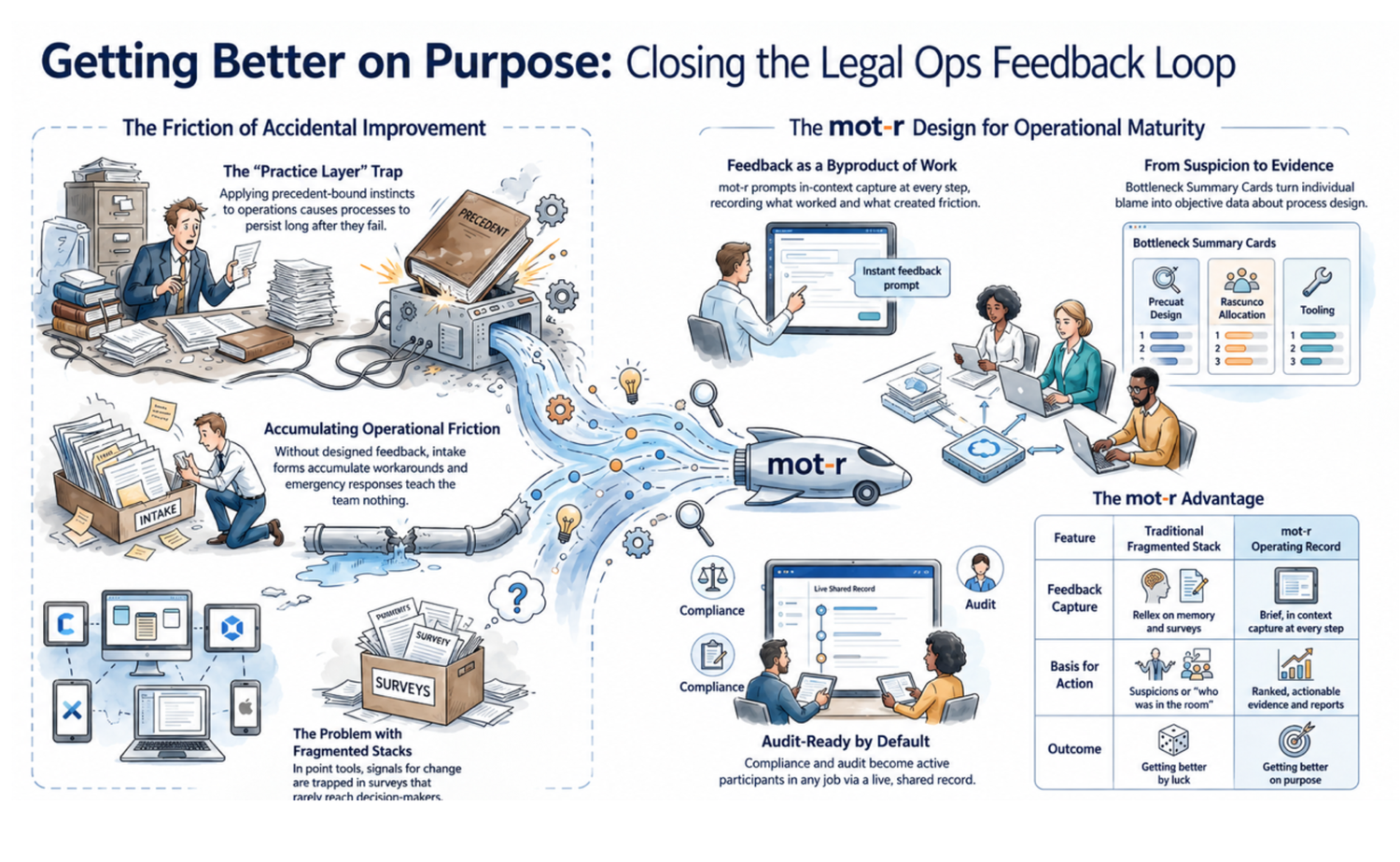
Learning and Improvement closes the feedback loop on purpose. Most departments have no designed mechanism for it, so improvement happens by accident, when someone with enough standing forces the question.
The deeper problem is evidence. Lawyers bring a rigorous evidence discipline to their legal work: they gather facts, test them, act, and revise as new facts emerge. The operating layer rarely gives them anything comparable to work with, so a process that should change persists long after it has stopped serving the team, because nothing shows that it has.
This is the mode that decides whether the other four improve at all, because Business As Usual processes that are never refined accumulate friction, emergency responses that are never reviewed teach nothing, adaptations that are never measured repeat the same mistakes, and Iceberg intelligence that is never connected back to outcomes never compounds.
The feedback mot-r needs is created as a byproduct of running the work. Improvement Collection, enabled on a workflow, prompts a brief in-context capture at each step from the person closest to it, recording what worked and what created friction, and the Suggested Improvements Report consolidates that into ranked, actionable evidence.
Client Feedback is a named report built on a short, consistent close at matter end, so the business's experience arrives as operational evidence while it is fresh, and a service-quality dispute becomes a shared-evidence conversation.
Bottleneck Summary Cards rank steps by cumulative stall time across all active work, which turns a suspicion about an individual into evidence about process design. These sit among more than 20 native reports the platform generates, each one falling out of the work as it moves.
No point tool has a designed feedback loop. In a fragmented stack, improvement waits on a survey that depends on memory and participation, or on whoever happened to be in the room last quarter.
Ranked evidence created inside the operating record, so the department gets better on purpose instead of by luck.
When the Modes Run at Once
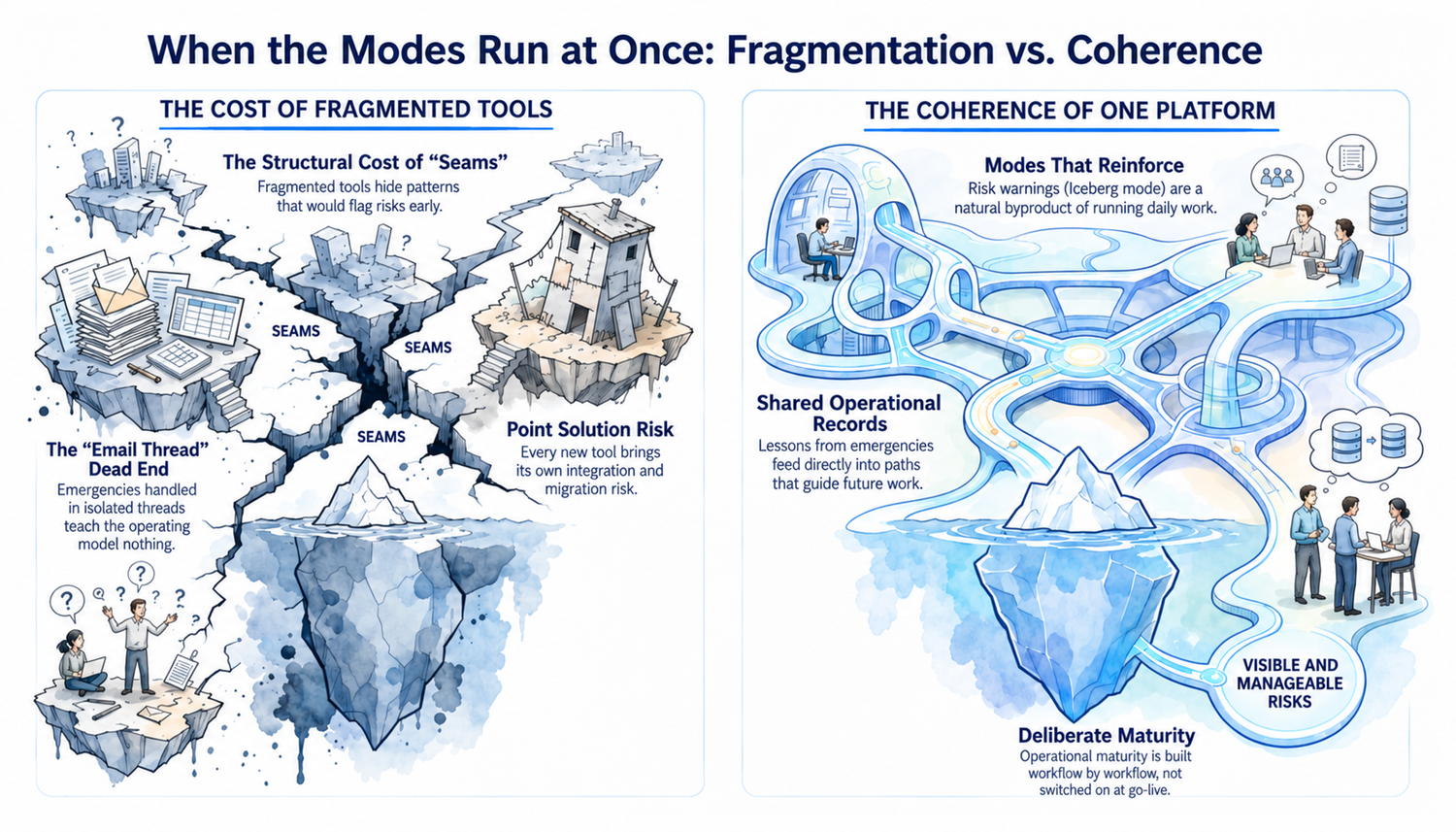
The real test is how a platform performs with all five modes running at once, which is the default under pressure. Many departments meet that by assembling tools: a contract or matter system for Business As Usual, something improvised for emergencies, a spreadsheet for compliance, a change order every time the business reorganizes, a survey for feedback. Each covers a single cell of the surface, one mode for one kind of work, and does that one thing acceptably.
The cost is structural and shows up in the seams. Fragmented tools keep the fragile system in place. The emergency that lives in an email thread teaches the operating model nothing, the Business As Usual evidence sitting apart from the compliance tool hides the pattern that would have flagged the risk early, and the improvement signal captured in a disconnected form never reaches anyone who can act.
On one platform the modes reinforce each other. The vital signs that warn in Iceberg mode are a byproduct of running Business As Usual. The picture that guides an emergency is the same Work in Progress view the team uses every day, so no one has to hold it in their head. When the business changes, the templates the team runs every day are the ones it adapts, and the same record shows whether the change worked. The Dynamic Worklist that coordinates the emergency feeds the path that encodes what the team learned, so the next comparable situation starts from a shared record.
What the department learns in one mode is available to every other mode. That coherence is the case for a single layer over any set of alternatives, and it is why the comparison that matters runs across all five modes at once, where a demonstration shows only one.
Two questions sit underneath a platform choice and outlast the feature comparison: when the vendor is acquired, what happens to the contracts, the data, and the roadmap. mot-r answers both directly, with a Termination for Convenience upon Change of Control clause in every agreement and a roadmap that serves customers, because there is no exit agenda driving it.
None of this lands on day one. The five modes describe what a mature operation can do, not what a platform switches on at go-live. The build is deliberate, one workflow at a time, each one run, read, and refined, until the modes stop competing for the same depleted attention and start reinforcing each other.
The point of one platform
A legal operation that can see its own system, act on what it sees, and get measurably better without asking its people to keep absorbing what the system will not.
Prove it in 60 Days.
Choose one of your real workflows. We'll configure it with your people and processes and agree in advance how success will be measured: cycle time, work in progress, stale work and first response time. Judge the evidence before you make a broader commitment. Expand from there only if it makes sense.