

FOR IN-HOUSE LEGAL TEAMS
How do you actually manage Legal as an operation?
Work arrives.
Priorities shift.
Risks emerge.
The business changes.
mot-r Ops gives Legal the evidence to see what is happening, learn from it and act on it, so the operation keeps pace with the business.
Legal runs in five modes at once.
Legal departments don't work on one thing at a time. They handle routine work, urgent business priorities, emerging risks, organizational change and continuous improvement, all at once. Managing Legal means keeping those modes in balance as the business changes.
Business as Usual
Eliminating administrative waste so attorneys focus on legal judgment rather than manual status tracking.
Emergency Response
Ensuring rapid mobilization and information coherence when high-stakes crises arrive without warning.
Looking for Icebergs
Scanning internal signals and operational evidence to identify strategic risks before they become crises.
Change & Adaptation
Adjusting workflows, approvals and responsibilities when reorganizations, new policies or new business change how Legal has to work.
Learning & Improvement
Closing the loop by turning operational evidence into institutional knowledge and better processes.
Each mode competes for the same people and time. Balancing them takes evidence, not instinct.
Operational coordination is never finished.
Every day introduces new work, changing priorities, resource constraints and emerging risks. The goal isn't to eliminate change. It's to continually adapt while keeping the department operating effectively.
- New work arrives
- Business priorities shift
- Risks escalate
- Deadlines move
- Resources change
- Approvals stall
Operational balance isn't achieved once. It's maintained continuously as conditions change.
What's your feedback loop?
You can't manage what you can't see. And you can't improve reliably without evidence you can trust.
Useful evidence is more than activity data. A ticket count tells you how busy Legal is. It doesn't tell you where the operation is drifting or what should change.
Ask five questions about how your department learns:
Does it provide useful evidence?
Not just activity counts, but evidence you can learn from.
Is it timely and accurate?
Current enough to act on, and reliable enough to trust.
Does it cover the entire operation?
Every channel, team and participant, not one system.
Does it reveal where Legal is drifting?
Where the way Legal works has fallen out of step with the business.
Can Legal act on what it tells you?
Without waiting for another IT or development project.
If the answer to any of these is no, Legal is managing on assumptions.
From drift to continuous improvement.
Legal departments don't become operationally mature by standing still. They improve by learning from every change, every request and every outcome. Feedback is what turns drift into improvement.
- 1Work: requests, decisions and approvals move through the operation
- 2Evidence: the work records what happened, who was responsible and how long it took
- 3Learning: Legal sees where it is drifting and why
- 4Action: Legal changes workflows, rules or responsibilities directly
- 5Better work: the next cycle runs better and creates new evidence
- ↺ Then the cycle begins again.
Each cycle leaves the department better prepared for the next change.
One coordinated operational view.
You can't coordinate what you can't see.
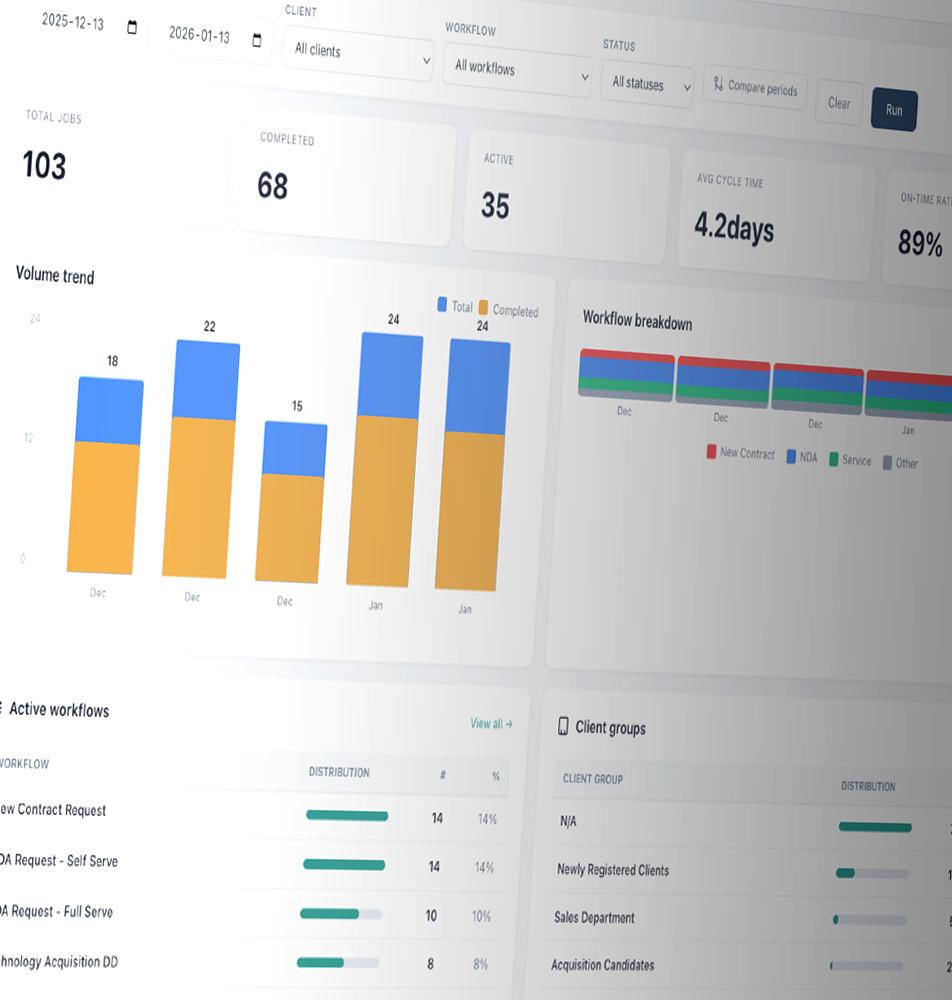
mot-r Ops brings workload, responsibility, bottlenecks, service levels and performance into one current view. Instead of assembling information from disconnected systems, leaders can see where work is accumulating, who owns what, where risk is increasing and where intervention is needed.
Visibility is only the start. It matters because it shows Legal what to change, and Legal can act on it.
Risk belongs where the work happens.
Many legal departments rebuild their risk picture periodically, from spreadsheets, emails and memory. In mot-r Ops, risk, responsibility and control maturity are captured in the workflow as the work moves, so the picture is current whenever leadership needs it.
No separate reconstruction before the next review.
The Legal Operating Layer
mot-r Ops runs on the Legal Operating Layer: an evidence-based management system across demand, priorities, capacity, workflows, decisions, risk, AI governance and continuous improvement. It connects the systems worth keeping.
- Demand
- Priorities
- Capacity
- Workflows
- Decisions
- Risk
- AI Governance
- Improvement
- Matter Management
- DMS
- CLM
- eBilling
- Teams
- AI Providers
The result isn't another system to manage. It's one coordinated way of running Legal.
Operational improvement should be measurable.
Operational maturity isn't a feeling. It should be visible in the way the department performs over time: cycle time, work in progress, stale work and first response time. Agree on the measures before you start, then watch them move.
Is intake becoming faster?
First response timeIs work flowing more smoothly?
Cycle timeWhere are bottlenecks emerging?
Stale workIs capacity staying balanced?
Work in progressAre risks increasing or decreasing?
Risk trendAre we becoming more effective over time?
Change across improvement cyclesProve it in 60 Days.
Choose one of your real workflows. We'll configure it with your people and processes and agree in advance how success will be measured: cycle time, work in progress, stale work and first response time. Judge the evidence before you make a broader commitment. Expand from there only if it makes sense.