

Foundation Series
Research on the operating realities of modern corporate legal departments
The mot-r Foundation Series is the research basis for how mot-r is built and why our Legal Operating Layer is designed the way it is. It examines the structural challenges shaping corporate legal operations. It explores the realities Legal Ops leaders face and the principles required to orchestrate legal work with visibility, control, and measurable impact.
The Quiet Crisis
Why Your Legal Team Is Struggling and What the Evidence Says You Can Do About It
Two-thirds of in-house legal professionals report moderate to severe stress, and nearly one in four of the most stressed are planning to leave within a year. The Quiet Crisis examines the structural forces driving burnout, turnover, and declining internal reputation in corporate legal departments—and introduces a validated organizational health framework to interrupt the cycle. This first paper in the mot-r Foundation Series provides a diagnostic lens for general counsel and Legal Ops leaders who know the problem isn’t effort—but structure.
These pressures are not isolated problems. They are symptoms of a reinforcing operational dynamic that affects many corporate legal departments.
Understanding the Corporate Legal Doom Loop
The Corporate Legal Doom Loop describes a self-reinforcing operational cycle in which rising legal demand, fragmented workflows, reputational pressure, and burnout compound inside corporate legal departments.
Rising demand for legal services overwhelms existing operating practices. Fragmented workflows limit the effectiveness of technology. Delays and friction erode legal’s reputation with the business, increasing leadership pressure and accelerating burnout.
As experienced professionals leave, remaining teams inherit even greater workloads—restarting the cycle and compounding its effects.
The research in the mot-r Foundation Series examines the structural forces behind this dynamic and provides frameworks leaders can use to interrupt it.

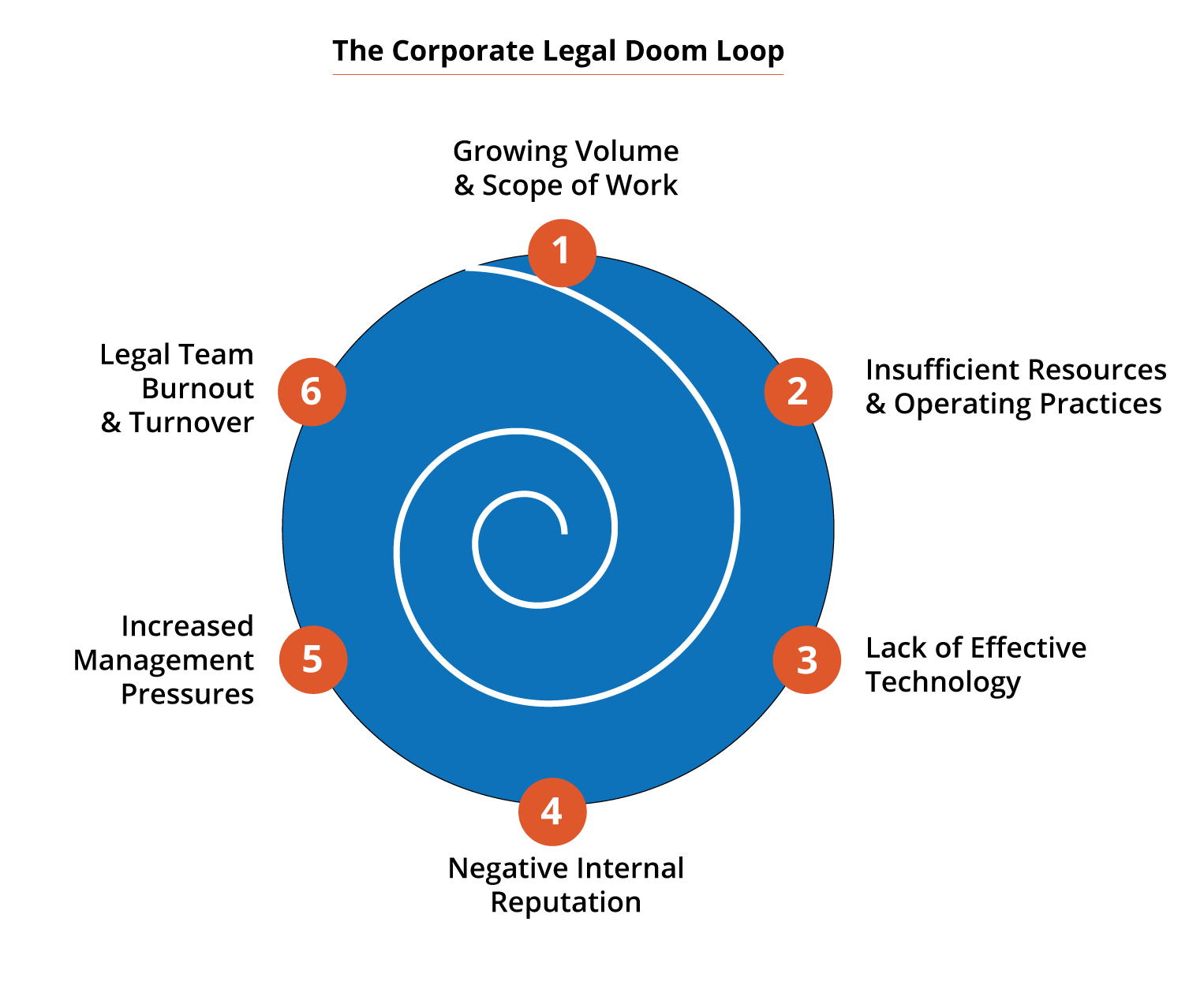
Figure 1. The Corporate Legal Doom Loop — a self-reinforcing operational cycle affecting corporate legal departments.
Seeing The System
Why Your Legal Department’s Problems Are Connected and What to Do About It
Every system is perfectly designed to get the results it gets. Your people aren’t the issue. This whitepaper is for General Counsel and legal operations leaders who have fixed the same problems more than once.
The Legal Work Flow Model describes how work actually moves through a legal department—from initial request to final outcome—and why unstructured intake creates persistent operational friction.
Most legal teams have already tried to fix these problems—adding tools, refining processes, and increasing effort. But the underlying issues persist.
In most legal departments, work enters through informal channels—email, messages, meetings, and ad hoc requests. Without structured intake, requests arrive incomplete, lack context, and are difficult to prioritize.
Teams compensate by reacting quickly. Work is handled based on individual judgment rather than shared visibility. As volume increases, coordination breaks down, and effort expands without improving outcomes.

Technology is often introduced to improve efficiency. But when applied to an unstructured system, it accelerates fragmentation rather than resolving it.
Over time, this creates a predictable pattern: limited visibility, inconsistent prioritization, and increasing pressure from the business.
This is not a capacity problem. It is not a talent problem. And it is not a technology problem. It is a structural problem.
When work is structured at the point of entry, downstream activities—prioritization, execution, and reporting—become measurable, manageable, and improvable.
The mot-r Foundation Series introduces system-level models leaders can use to redesign how legal work flows—and to finally break patterns that incremental improvements cannot fix.
The Wrong Verdict
Why Legal Gets a Reputation It Doesn't Deserve
The dysfunction visible inside your legal department may be a superficial view of forces that began well outside it. The Wrong Verdict traces the structural chain — from capital markets logic and CEO tenure compression to disconnected circles of competence and the psychology of displaced blame — that produces the wrong reputation for legal teams who did nothing to deserve it. This third paper in the mot-r Foundation Series provides general counsel and legal operations leaders with a full account of how the verdict formed, and why understanding its origins changes everything about how to respond to it.
The verdict was never evidence-based. It was system-generated.
Legal's greatest contributions — the risk that didn't materialize, the litigation that never started, the deal that closed cleanly — leave no trace. There is no report that captures a prevented catastrophe. No number that exonerates the way a missed sales target can be redeemed next quarter. Legal's value is invisible by design, and an invisible contribution cannot correct a visible reputation.
The Wrong Verdict examines the mutually reinforcing forces that make this outcome structurally inevitable: short-termism that discounts long-horizon risk, executive incentive structures that make deferral rational, operating environments that degrade the quality of judgment being applied, and a shame-displacement mechanism that needs somewhere to go. Together, these forces don't add — they multiply.
What gets called friction is the network doing its job. The paper provides the understanding that changes not the tools legal uses, but the person using them.
The Seven Forces Behind the Wrong Verdict
Legal's reputation problem wasn't created inside the legal department. It was produced by a compounding set of structural forces — each damaging on its own, multiplicative together.
Capital Markets Logic Quarterly earnings pressure makes legal's long-horizon value structurally invisible. Costs that arrive immediately but return value in years become targets when quarters are tight.

CEO Tenure Compression With median tenures of five years or less, rational executives don't invest in returns they won't see. Legal's value is almost entirely outside that window.
The Reinvention Imperative Accelerating competitive disruption intensifies short-term pressure at precisely the moment rigorous risk assessment matters most — and gets cut first.
Disconnected Circles of Competence Executives rise through commercial functions and encounter legal as an obstacle. By the time they reach the C-suite, the exclusion of legal's contribution isn't a knowledge gap. It's a conclusion.
Frenetic Operating Conditions Sustained information overload degrades the frontal lobe functions responsible for nuanced judgment — producing black-and-white thinking in the people whose assessment of legal's value matters most.
No Revenue Line Legal's greatest contributions are invisible by definition. Without a number that can be redeemed, the narrative has no correction mechanism. Every friction event confirms it further.
Shame Displacement Unacknowledged gaps between what was committed and what was understood reliably precede displaced anger. Legal is available, carries no revenue line to complicate the story, and has been accumulating a relational record that makes each new grievance feel like confirmation.
Together, these forces don't add. They multiply.
Beyond Endurance
What Resilient Legal Operations Actually Require
The endurance keeping your legal department afloat is the very thing preventing anyone from fixing it.
For general counsel and Legal Ops leaders who can no longer ask their people to absorb more.
The Misreading of Endurance
The endurance keeping legal departments afloat is the same thing preventing anyone from fixing them.
Paper IV picks up where Paper I left off. The doom loop produces overwork, damaged reputations, and burnout, and the personalities working inside it are a particularly poor match for those conditions. The response has been to push harder. That response is admirable, and it has been misread.
The mechanism is the heroic system. Conscientious high performers carry the load through individual effort. The paralegal who runs the master spreadsheet. The legal ops manager who copy-pastes from the ERP every morning so the matter records are right. The senior commercial lawyer everyone in sales routes year-end deals through. The work gets done, the structural problem stays invisible, and the people inside the system pay the cost privately. Robustness, the usual operational aim, isn't enough either, because legal environments shift too much for any static design to hold.
What the department needs instead is operational resilience, distinct from personal resilience. Operational resilience is a property of the system. It is built into how work is assigned, how teams are supported, and how stress is detected and absorbed. When resilience is treated as personal, the burden falls on the people inside the system. When it is treated as structural, the burden falls on the system that surrounds them.

A resilient system has to sense and respond continuously. The paper uses Boyd's OODA loop here, with orient at the center, where new information becomes a working picture of reality and the quality of that picture governs everything downstream. Legal's orient stage is where the department is most exposed, because its operational picture has been distorted by the doom loop and by a reputation it did not earn.
The paper then turns to what to put in front of the people doing the work. Operational vital signs (cycle time, work-in-process by practice area, stale and overdue work, client satisfaction at matter close, and team attrition) diagnose anything only as a set. Friction in this frame is signal. Bottlenecks, delays, and overload tell you where the system needs to adjust. The discipline is to be hard on the process and not the people. The principles that govern knowledge work apply to corporate legal departments too.
The closing synthesis pulls the four papers together. The system produces suffering, distorts reputations, pushes risk into the tail, and falls short of the service the business expects. Endurance was the only response on offer, and it wears people out without changing the conditions that cause the failure. What replaces it is shared infrastructure: people, process, measures, and technology working together so the department can operate under uncertainty without running on human endurance.
When resilience is treated as personal, the burden falls on the people inside the system. When it is treated as structural, the burden falls on the system that surrounds them.