

mot-r Foundation Series
February 2026
The Quiet Crisis
Why Your Legal Team Is Struggling and What the Evidence
Says You Can Do About It
The unnecessary suffering in your legal department is not inevitable. It is structural, it is measurable, and it can be changed. For general counsel and legal operations leaders who suspect the problem isn’t effort.
Executive Summary
Two-thirds of in-house legal professionals report moderate to severe workplace stress.One in four of the most stressed are planning their departure within twelve months. The annual cost of stress-driven turnover in a single mid-sized legal department approaches seven figures. These numbers are confirmed across every major industry survey—ACC, CLOC, Thomson Reuters, EY, Axiom—and the trajectory is worsening.
This paper argues that the crisis is not caused by insufficient effort, inadequate technology, or a shortage of talent. It is caused by a reinforcing structural cycle—a doom loop—in which six conditions feed one another: growing volume arrives without structural support, which overwhelms operating practices, which technology fails to fix, which damages the department’s internal reputation, which triggers management pressure focused on throughput rather than outcomes, which produces burnout and departure—which increases volume for the team that remains. The cycle does not just repeat. It accelerates.
Conventional responses—new technology, restructuring, resilience programs, benchmarking—consistently disappoint because they address individual stages without interrupting the cycle that connects them. Drawing on Peter Drucker’s foundational research on knowledge-worker productivity, we show that most improvement efforts skip the most important question: not how do we do this work more efficiently? but what is the task?
To see the full system, this paper applies McKinsey’s Organizational Health Index—a framework validated across more than 2,600 organizations and eight million survey respondents—to corporate legal departments for what we believe is the first time. The nine elements of organizational health map directly onto the stages of the doom loop, revealing that every stage involves multiple dimensions of organizational health and that single-point interventions will always be insufficient.
The paper concludes with a diagnostic exercise any leader can perform this week: ask five people on your team what makes them unproductive, and listen without defending. The patterns that emerge will tell you where your particular doom loop is most active—and where the subsequent papers in this series will be most immediately relevant.
Throughout, we hold ourselves to the five principles of evidence-based management. When we cite a study, we note its methodology and limitations. When we recommend a practice, we distinguish between what the evidence supports and what it does not. When the honest answer is we don’t know yet, we say that.
The suffering in your legal department is not inevitable. It is structural, it is measurable, and it can be changed. This paper shows you where to look. The papers that follow will show you how to begin.
This is the first paper in the mot-r Foundation Series.This paper shows you where to look. The papers that follow will show you how to begin.
The Human Cost
The Stress Crisis in In-House Legal
If you lead a corporate legal department or manage its operations, you already know something is wrong. You can see it in the turnover, the fatigue, and the growing gap between what the business expects and what your team can deliver. You have tried to fix it—with technology, restructuring, and sheer effort. Yet the problems persist.
This paper is for you. Not because the situation is your fault—it is not—but because you are the person in a position to change it, and the system you are operating inside has not given you the tools to see why your previous efforts have not worked. That is what this paper aims to provide—including why the profession’s own information ecosystem has systematically filtered out the failure data you most needed to see.
Two-thirds of in-house legal professionals report moderate to severe workplace stress. One in five rates their stress as high or severe. These findings come from the Association of Corporate Counsel’s December 2025 State of Stress report—one of the most rigorous studies the profession has produced on this subject.
The numbers are not anomalies. They are confirmed across multiple surveys and methodologies across the profession.
Confirmed across the profession:
63% of legal departments cite workload and resource bandwidth as their top
challenge, with 83% expecting demand to increase. 76% find it challenging to
manage current workloads, and 75% say growth will outpace budgets. 100% of
respondents in one independent survey reported increases in both volume and
complexity of the matters they support.
— CLOC/HBR Consulting (2025, 186 orgs, 15 industries), EY/Harvard Law School (2021, 2,000
interviews, 17 industries), Axiom/Wakefield Research (2023)
The ACC data reveals what this means in human terms. Long hours intensify stress dramatically. High stress multiplies the risk of departure. A significant portion of the most stressed professionals are already planning their exit.
The human impact, measured:
Professionals working 55+ hours per week are five times more likely to report high
stress. High stress amplifies attrition risk by a factor of three to five compared to
moderately or mildly stressed staff. And 24% of the most stressed professionals
are actively planning their departure in the next twelve months.
Note: The attrition multiplier is based on reported departure intentions, not tracked departures—
directionally consistent with every other data source but not experimentally validated.
— ACC State of Stress (Dec 2025)
That last finding deserves careful attention, because it carries a financial weight that transcends the individual. When a senior in-house lawyer leaves, the organization loses not just a professional but a reservoir of institutional knowledge—relationships with business units, understanding of commercial context and deal history, familiarity with regulatory landscape and company-specific risk patterns—that took years to accumulate and cannot be quickly replaced.
The cost of departure:
Gallup’s workplace research estimates replacing a single employee costs between
one-half and two times annual salary—a figure Gallup itself describes as
conservative. Industry median base salaries range from approximately $180,000
for mid-level counsel to well over $350,000 for general counsel. Across that range, a
single mid-level departure could cost $90,000 to $360,000 when recruitment,
onboarding, lost productivity, and institutional knowledge erosion are included.
For a department experiencing three to five stress-driven departures a year—which
is what the ACC’s 3–5x attrition multiplier among high-stress professionals would
predict—the annual cost approaches seven figures before accounting for the
cascading effects on the team that remains.
— Gallup (2019, general workforce), ACC/Empsight Compensation Survey (2025)
For those who need to make this case in the language of the business: suffering is cost. Every departure triggers recruitment spend, onboarding time, and a productivity gap that persists long after the new hire starts—particularly in knowledge-intensive roles where institutional context takes months to rebuild. Disengagement is reduced capacity—people still present but no longer contributing discretionary effort, judgment, or innovation. Burnout is operational risk—exhausted professionals make more errors, miss more signals, and are less likely to raise concerns before they become incidents. The human cost and the financial cost are not separate problems. They are the same problem described in different vocabularies.
What makes this data particularly urgent is the trajectory. Axiom’s annual surveys have measured the same population—U.S. in-house counsel across seniority levels—over three consecutive years, and the pattern they reveal is not one of simple crisis—it is something more troubling.
In 2022, severe burnout affected roughly half the profession. A year later, it had jumped dramatically. Then something instructive happened. By 2024, severe burnout had dropped meaningfully—but nearly everyone still reported stress at some level. Satisfaction continued to erode. And the nature of the flight risk shifted dramatically: the majority of respondents said they wanted to move outside of in-house roles altogether. Not to a different legal department. Out of the profession as practiced.
Three years of trajectory:
2022: 47% reported being very or extremely stressed or burned out.
2023: Severe burnout rose to 61%—a 14-point increase in a single year. Active job
searching rose from 14% to 21%.
2024: Severe burnout dropped to 39%. But 97% still reported some level of stress
or burnout. Satisfaction fell 12 points below 2022 levels. And 71% said they wanted
to move outside of in-house roles entirely.
— Axiom/Wakefield Research, View from the Inside survey series (2022–2024)
The mid-level data sharpens this picture further. Among the lawyers a department depends on most for day-to-day execution, 55% were dissatisfied and 70% were seeking or open to new roles—substantially more mobile than senior leadership. These are not the sentiments of a workforce experiencing temporary stress. They are the sentiments of people who have concluded that the system they work within is not going to change.
— Axiom/Wakefield Research, 2nd Annual View from the Inside (2023)
This trajectory is consistent with what the organizational health literature—discussed in detail later in this paper—would lead us to expect when acute symptoms are addressed without changing the structural conditions that produce them. The emergency passes. The visible crisis moderates. The signals that triggered urgency—visible distress, public departures, team conflict—fade. And in any organization managing competing priorities with finite attention, that moderation looks like progress. It is an entirely rational response to the available signals. But the only thing that changed was the volume. People are no longer at the breaking point. They are simply disengaged and planning their exit. These conditions are structural—but structural conditions can be changed. The framework for how is the subject of this paper.
The suffering has not been resolved. It has gone quiet.
Professionals working more than 55 hours per week are five times more likely to report high stress.
High stress amplifies attrition risk by three to five times compared to moderately stressed staff.
Twenty-four percent of the most stressed professionals are actively planning their departure within the next twelve months.
The Financial Cost of Turnover
That final finding carries financial implications that extend far beyond individual departures.
When a senior in-house lawyer leaves, the organization loses not only a professional but a reservoir of institutional knowledge. This includes relationships with business units, knowledge of commercial context and deal history, familiarity with regulatory environments, and understanding of company-specific risk patterns.
Gallup estimates that replacing a single employee costs between one-half and two times annual salary.
Industry median base salaries for in-house counsel range from roughly $180,000 for mid-level counsel to more than $350,000 for general counsel.
Across that range, a single mid-level departure could cost between $90,000 and $360,000 once recruitment, onboarding, lost productivity, and institutional knowledge erosion are considered.
For a department experiencing three to five stress-driven departures a year, the annual cost approaches seven figures before accounting for the cascading effects on the remaining team.
For leaders who must communicate these realities in business terms:
Suffering is cost.
Every departure triggers recruitment spending, onboarding time, and productivity gaps that persist long after new hires arrive.
Disengagement reduces capacity. Burnout increases operational risk.
Exhausted professionals make more errors, miss signals, and are less likely to raise concerns before problems escalate.
The human cost and the financial cost are the same problem expressed in different languages.
Burnout Trends in the Profession
The trajectory of this data is equally concerning.
Axiom’s surveys of in-house counsel over several years reveal a troubling pattern.
In 2022, approximately 47 percent reported severe stress or burnout.
In 2023, severe burnout rose to 61 percent.
By 2024, severe burnout had fallen to 39 percent—but nearly everyone still reported some level of stress or burnout.
Ninety-seven percent of respondents reported some level of stress.
Satisfaction fell twelve points compared to 2022.
Most concerning, seventy-one percent said they wanted to move outside of in-house roles entirely.
Not to another legal department.
Out of the profession as practiced.
Among mid-level lawyers—the professionals most responsible for day-to-day execution—55 percent reported dissatisfaction and 70 percent were open to new roles.
These are not the sentiments of a workforce experiencing temporary stress.
They are the sentiments of professionals who have concluded the system they work within will not change.
The suffering has not been resolved.
It has gone quiet.
The Pattern Behind the Crisis
At first glance, the pressures affecting corporate legal departments appear to be separate problems: rising workloads, technology frustration, strained relationships with business teams, and increasing burnout.
In reality, these pressures are connected. They form a reinforcing operational cycle in which each condition amplifies the next. Understanding that cycle is the key to understanding why many improvement efforts fail.
What Is the Corporate Legal Doom Loop?
The Corporate Legal Doom Loop is a reinforcing operational cycle that causes workload pressure, operational breakdown, reputational decline, and burnout inside corporate legal departments.
As legal demand increases without structural operating practices, departments fall into reactive workflows. Technology implementations fail to solve the underlying problem. Internal reputation deteriorates, leadership pressure increases, and burnout drives turnover. The resulting loss of capacity increases workload for the remaining team, restarting the cycle.
Over time the cycle accelerates.
Most legal departments recognize individual symptoms of this pattern, but few see the system that connects them.
The cycle typically unfolds across six stages.
The Six Stages of the Corporate Legal Doom Loop
1. Growing Volume and Scope of Legal Work
2. Insufficient Resources and Operating Practices
3. Technology That Fails to Solve the Real Problem
4. Declining Internal Reputation
5. Increasing Management Pressure
6. Burnout and Turnover
How the Corporate Legal Doom Loop Reinforces Itself
The Corporate Legal Doom Loop is not a sequence of independent problems. Each stage reinforces the next, creating a self-sustaining operational cycle inside corporate legal departments.
Rising legal demand overwhelms existing operating practices. Broken workflows make technology less effective. Delays and friction damage legal’s reputation with the business. Leadership pressure increases. Burnout and turnover follow.
When experienced professionals leave, the remaining team absorbs additional workload—restarting the cycle and accelerating its effects.
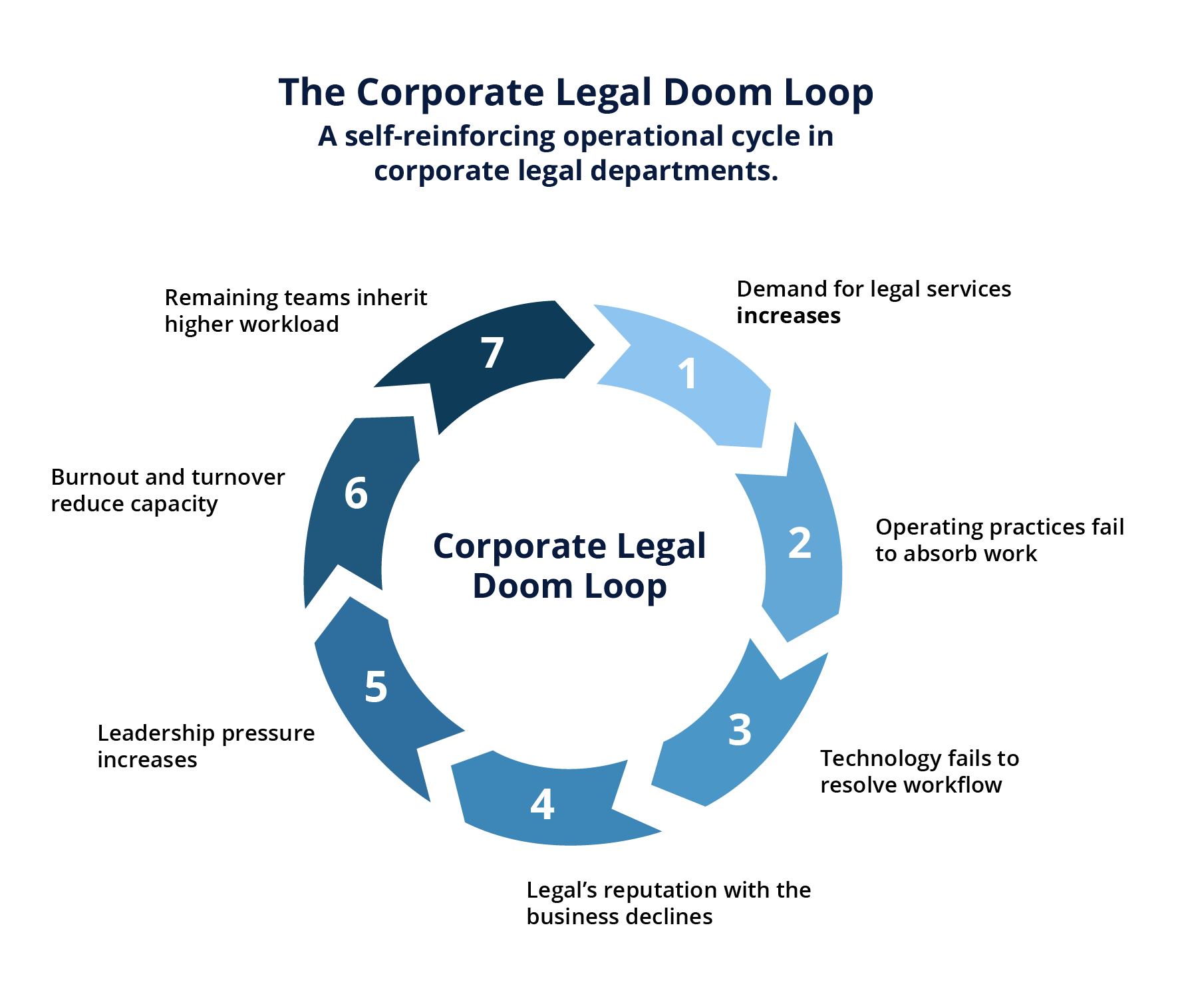
This reinforcing dynamic can be understood as a repeating operational cycle (Figure 1).
1. Demand for legal services increases
2. Operational practices fail to absorb the work
3. Technology fails to resolve workflow friction
4. Legal’s reputation with the business declines
5. Leadership pressure increases
6. Burnout and turnover reduce capacity
7. Remaining teams inherit even higher workload
Figure 1.The Corporate Legal Doom Loop — a self-reinforcing operational cycle affecting corporate legal departments.
A Framework for Understanding Legal Department Pressure
The Corporate Legal Doom Loop provides a framework for understanding why operational pressure inside corporate legal departments persists despite technology investment, restructuring, and increased effort. By viewing these conditions as a reinforcing system, leaders can identify where targeted changes will interrupt the cycle.
The Corporate Legal Doom Loop
Growing Volume and Scope of Legal Work
“A bad system will beat a good person every time.”
— W. Edwards Deming
The persistence of these conditions arises from a fundamental misunderstanding.
The problems facing legal departments are not separate issues. They are a system.
Each condition creates the conditions for the next.
The result is a reinforcing cycle—a negative flywheel—in which each stage accelerates the next.
The cycle begins with growing volume and scope of work.
Pressure arrives from multiple directions: litigation, investigations, regulatory compliance, risk management, and ESG responsibilities.
Each new demand expands the department’s mandate without proportional increases in headcount or structural support.
Every corporate legal department operates under a dual mandate.
Enable the business to succeed.
Manage the risks associated with how it succeeds.
Every item arriving on the department’s workload touches one side of this mandate or the other.
And it all arrives without prioritization, triage, or coordination.
The scope continues expanding.
Nearly half of Chief Legal Officers report increasing litigation volume.
Forty-two percent report increases in internal investigations.
More than one-third report litigation becoming more complex.
At the same time, CLO responsibilities continue expanding.
Compliance oversight, risk management, and ESG leadership responsibilities continue to grow.
More than half of CLOs now directly manage at least three additional corporate functions.
Insufficient Resources and Operating Practices
As the volume of work increases, most legal departments reach a point where their existing operating practices can no longer absorb incoming demand.
Processes remain largely manual. Intake is inconsistent or chaotic. Work is prioritized based on urgency rather than strategic value.
Resources are allocated informally, often based on whichever request appears most urgent or comes from the most senior stakeholder.
Strategic work is deferred in favor of immediate issues.
In departments operating under these conditions, something is always on fire.
Interestingly, the professionals working inside these systems often do not believe the solution is simply more headcount.
Survey data from in-house lawyers reveals an important distinction between being under-resourced and being under-staffed.
Many professionals report feeling under-resourced while simultaneously believing that hiring additional lawyers would not solve the underlying problem.
The issue is not only the number of people available. It is how work is organized, coordinated, and supported.
Without operational structure, additional staff often become absorbed into the same reactive workflow patterns.
The system continues operating in crisis mode.
Technology Failure
When operating practices begin to break down under increasing demand, organizations frequently turn to technology as the solution.
Technology is expected to create efficiency where operational structure does not yet exist.
Unfortunately, this expectation often leads to disappointing results.
Legal departments regularly report failed or underperforming technology implementations.
These failures rarely occur because the technology itself is defective.
More often, they arise from deeper structural issues.
Common causes include:
• purchasing technology before clearly defining the workflow it is meant to support
• implementing tools on top of broken or inconsistent processes
• implementation timelines that stretch far longer than expected
• low adoption among lawyers or business users
• measuring success based on implementation completion rather than operational impact
As a result, legal teams frequently experience technology as an additional system to manage rather than a tool that meaningfully reduces workload.
The tool functions as designed.
The underlying workflow remains broken.
The net effect is more administrative overhead.
Negative Internal Reputation
When legal departments struggle with increasing work volume, insufficient operating practices, and technology that fails to reduce workload, the next stage of the cycle begins to emerge.
The department develops a negative internal reputation.
The outcome is paradoxical.
The lawyers inside the department are often working longer hours and carrying more institutional risk than anyone else in the organization.
Yet the perception from internal business partners can become increasingly negative.
Legal begins to be viewed as:
• slow
• bureaucratic
• disconnected from business needs
• an obstacle rather than a partner
Research on internal perceptions of legal departments reveals a significant gap between how legal professionals view their relationships and how the business experiences them.
Most legal professionals report positive internal relationships.
However, business teams often describe legal services as slow and difficult to access.
Many employees report bypassing legal entirely when possible.
This reputational damage is rarely intentional.
It develops gradually as a consequence of operational strain.
And because lawyers typically see only a portion of the organization’s interactions with legal, the reputational shift often occurs without the department fully recognizing it.
Increased Management Pressure
As the department’s reputation declines and costs rise, leadership pressure begins to increase.
Executives seek explanations for delays, rising legal expenses, and operational friction.
Legal departments are increasingly evaluated using metrics that are easy to measure but poorly suited to knowledge work.
Examples include:
• number of matters completed
• contract turnaround times
• outside counsel spending
• internal response times
These metrics emphasize throughput rather than outcomes.
The shift toward throughput metrics rarely reflects a lack of concern for quality.
Instead, it reflects the limits of visibility within existing management systems.
Throughput is measurable.
Strategic value is harder to quantify.
Under pressure, organizations default to managing what they can see.
General counsel themselves often become trapped within this dynamic.
They understand the limitations of throughput metrics but must still operate within executive expectations shaped by financial reporting and cost control.
The general counsel, like the team they lead, becomes part of the same structural cycle.
Burnout and Turnover
Eventually the pressures created by this cycle reach a point where they become visible in the form of burnout and turnover.
Professionals leave not only because they are exhausted but because they no longer see a viable path forward inside the system.
Departure becomes a rational career decision. Institutional knowledge leaves with them. Relationships with business units disappear. Operational expertise accumulated over years walks out the door.
The remaining team absorbs the additional workload. Less experience is available to handle it.
Stress increases further. The cycle restarts. This is the final stage of the doom loop.
But it is also the stage that feeds directly back into the beginning. The departure of experienced professionals increases workload for those who remain. The system begins the next rotation.
Why the Usual Fixes Don’t Work
Most legal departments are aware that something is wrong.
Leaders attempt to address the problem using the tools available to them.
These tools typically include:
• purchasing new technology
• restructuring teams
• hiring consultants
• benchmarking against other departments
These initiatives often produce limited results. Not because the leaders implementing them lack skill or commitment. But because they begin with the wrong question. Peter Drucker identified this pattern decades ago in his research on knowledge-worker productivity. Organizations frequently begin by asking how work can be done more efficiently.
However, the more fundamental question is different. What is the task? Without clearly defining the task, improvement initiatives attempt to optimize activities without understanding their purpose.
The result is improvement efforts that solve the wrong problem.
The Drucker Framework
Drucker described three levels of understanding knowledge work. Each level builds on the previous one. Each requires a different type of organizational reflection.
Elimination
The first question is:
What work should we stop doing?
Knowledge workers are often consumed by tasks that do not represent the core purpose of their role.
Drucker referred to these tasks as “chores.”
In legal departments, these may include:
• administrative coordination
• manual status reporting
• document chasing
• intake triage that could be handled through structured processes
Eliminating these tasks is not simply a matter of efficiency.
It is a prerequisite for improving how the department operates.
Contribution
The second question asks:
What should each role contribute?
This reframes work from activity to value.
For example:
A contracts lawyer contributes deal velocity and risk clarity.
A regulatory lawyer contributes compliance confidence and strategic foresight.
Defining roles based on contribution rather than activity changes how performance is evaluated.
Outcomes
The third question is the most important.
What results should the department produce?
For corporate legal departments, the answer usually centers on a dual mandate.
Enable the business to succeed.
Manage acceptable levels of risk.
Every process, investment, and operational decision should support one or both of these outcomes.
Organizational Health Index
To evaluate the structural conditions affecting legal departments, this research applies McKinsey’s Organizational Health Index.
The framework evaluates nine elements that determine whether an organization can sustain performance over time.
These elements fall into three broader categories.
Internal alignment includes:
• direction
• leadership
• culture and climate
Quality of execution includes:
• accountability
• coordination and control
• capabilities
• motivation
Capacity for renewal includes:
• external orientation
• innovation and learning
When mapped against the stages of the corporate legal doom loop, these elements reveal where operational breakdowns occur.
For example:
Growing workload often reflects problems with strategic direction and external orientation.
Manual processes reflect weaknesses in coordination and operational control.
Declining internal reputation signals challenges in external orientation and organizational culture.
Burnout and turnover often reflect declining motivation, capabilities, and leadership alignment.
Because each stage of the cycle involves multiple elements of organizational health, single-point solutions rarely succeed.
Improvement requires addressing the system as a whole.
Path Forward
The doom loop is not inevitable.
It is a reinforcing cycle.
And reinforcing cycles can be interrupted once they are understood.
The purpose of this paper is diagnostic.
It identifies the structural dynamics that create the pressures experienced by legal teams.
Future papers in this series explore how leaders can address each stage of the cycle.
The most immediate step any legal leader can take is simple.
Ask the people doing the work what prevents them from doing it well.
Three questions are particularly revealing:
What is the single biggest obstacle preventing you from doing your best work?
What task consumes your time but adds little value?
If you could change one thing about how the department operates, what would it be?
Patterns that emerge across these conversations often reveal where the cycle is most active.
Once the entry point is visible, targeted changes become possible.
Sources and Methodology
This research draws on multiple large-scale studies examining the experience of in-house legal professionals.
Key sources include:
• Association of Corporate Counsel surveys of in-house legal departments
• CLOC and HBR Consulting industry research
• Thomson Reuters corporate legal department studies
• Axiom surveys of in-house lawyers and legal leaders
• Gallup workplace research on employee turnover
• McKinsey Organizational Health Index data
• Peter Drucker’s research on knowledge-worker productivity
Where survey data reflects perceptions rather than objective measurement, that limitation is noted.
Where research findings are directional rather than experimentally validated, those distinctions are acknowledged.
The goal of this series is not to offer definitive answers but to provide a transparent framework for examining the operational conditions affecting corporate legal departments.
Readers are encouraged to review the underlying sources and draw their own conclusions.