

A mot-r reference
The Four Operating Modes
The work surface, the forces on it, and the issue worth tackling first in each mode.
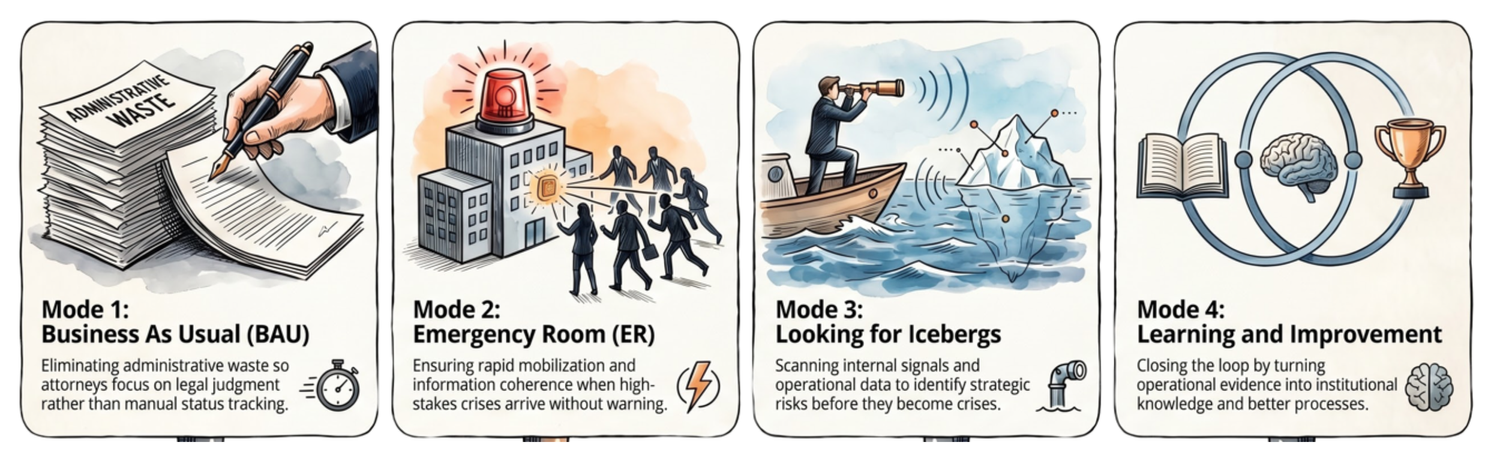
The work surface
A legal department runs four kinds of work at once. It handles the daily volume that keeps the business moving, in Business As Usual; it mobilizes around the serious, time-sensitive problem, in the Emergency Room; it scans the horizon for the risk that has not arrived yet, Looking for Icebergs; and it closes the loop by learning from all of it, in Learning and Improvement.
The four run concurrently. Cutting across them is every kind of law the business generates, from commercial and employment to litigation, privacy, intellectual property, corporate, and regulatory. The modes and the practice areas together form the department’s complete work surface.
Two kinds of force act on that surface. The first is External Pressures that never let up. The second is Adaptation, the episodic events that reshape the surface from inside the business and around it. Between those forces and the people sits the operating model, the one thing the department actually controls.
The strain that shows up inside this surface is produced by the conditions. This document takes each mode in turn and names the single issue worth tackling first, because a team that tries to fix everything at once usually fixes nothing.
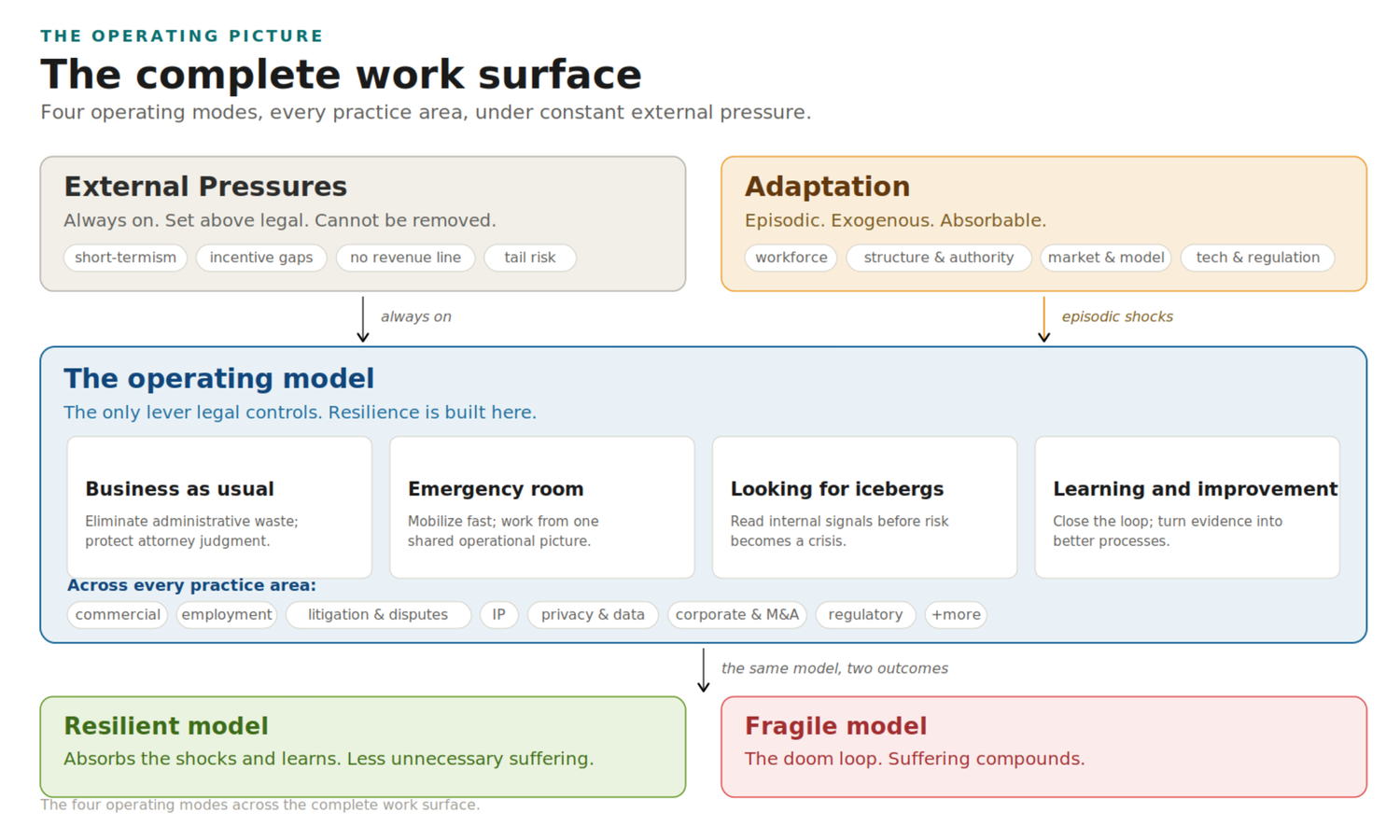
The work surface: four operating modes across every practice area, under the External Pressures and the adaptation events. The operating model is the one lever the department controls.
Mode 1 of 4
Business As Usual
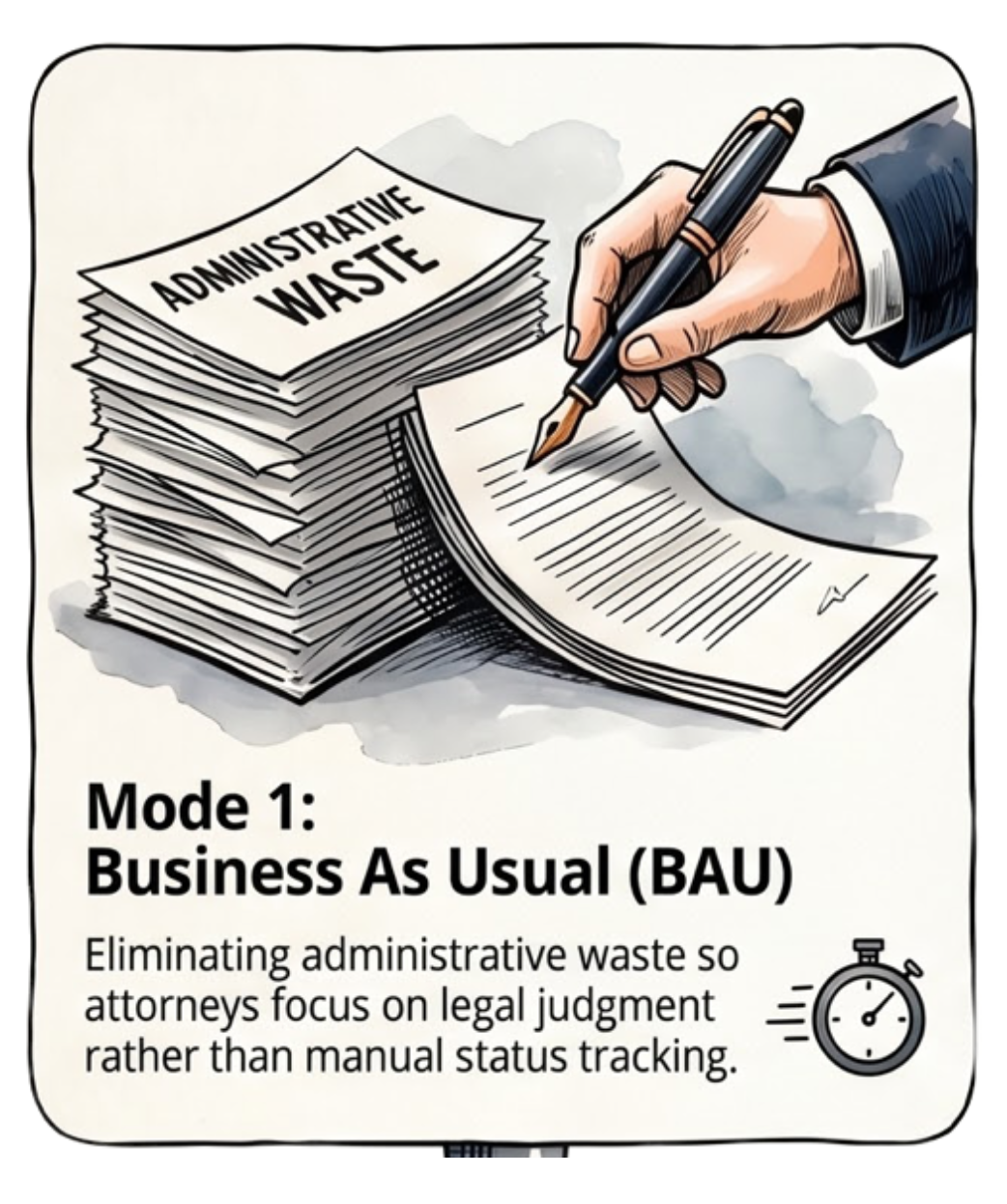
Effectiveness, efficiency, and the systematic elimination of work that should not exist
The doom loop begins with volume arriving faster than the operating model can absorb it. Processes stay manual, intake stays chaotic, and resources go to whoever escalates loudest.
Departments hide this from themselves through what is best called a heroic system. It keeps running because conscientious people hold it together.
Tackling it starts with making the work visible and separating what needs attorney judgment from everything else at the point of intake, so routine matters move to a lighter path and the work that genuinely requires a lawyer arrives with full context.
Mode 2 of 4
Emergency Room
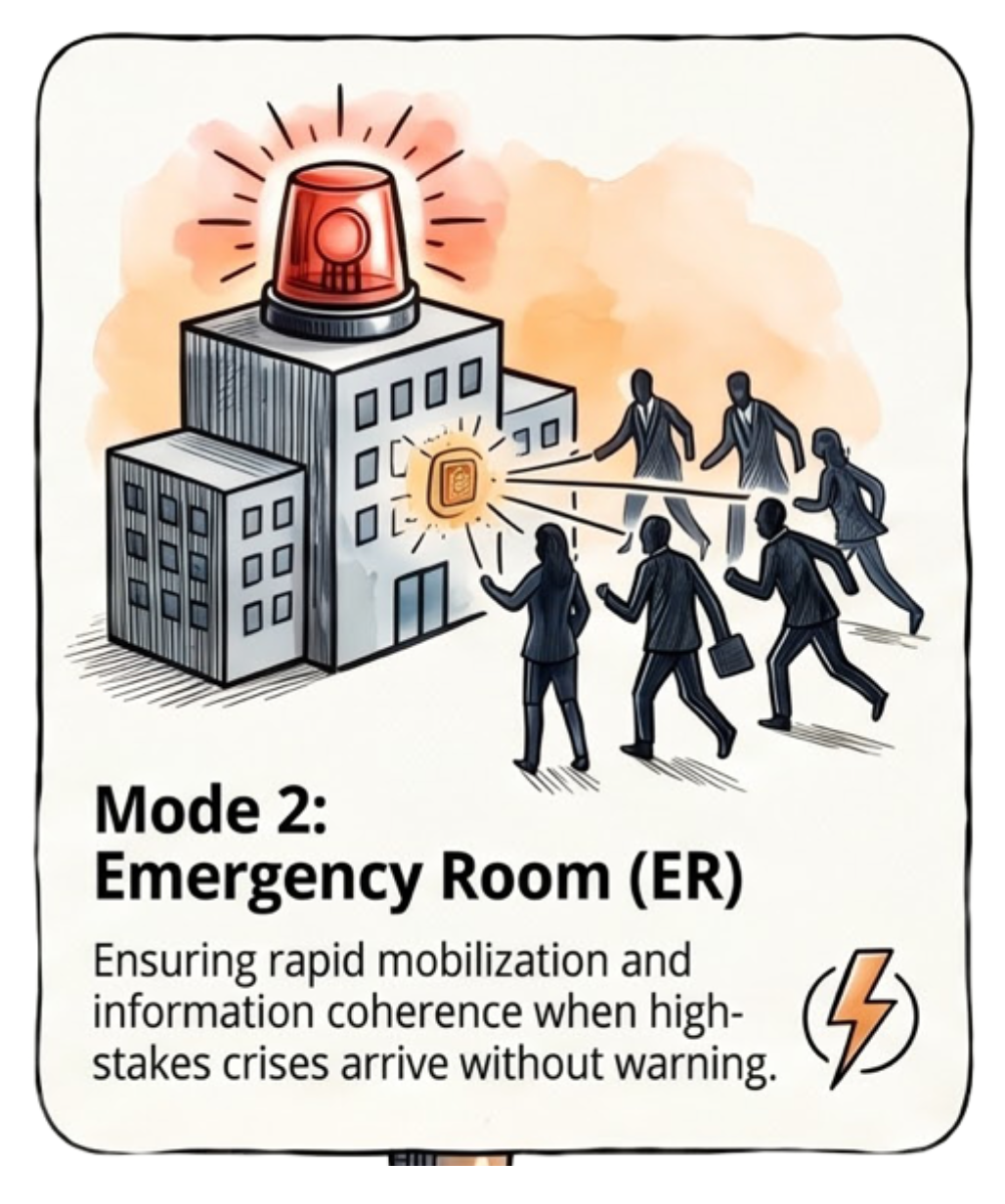
Concentrated response to serious, time-sensitive problems in the business
Taleb's continuum is the useful frame: fragile systems degrade under stress, robust systems absorb it, and antifragile systems gain from it.
Most legal departments sit at the fragile end, and the usual aspiration is robustness. Robustness alone falls short, because legal environments shift too much for a static operating model to hold.
A resilient operation senses and responds continuously, which is the OODA loop. The quality of the operational picture governs everything downstream.
Tackling it means holding the operational picture in a shared record from the first moment, visible to everyone working the response, so it does not have to be reconstructed afterward from memory and scattered threads.
Mode 3 of 4
Looking for Icebergs
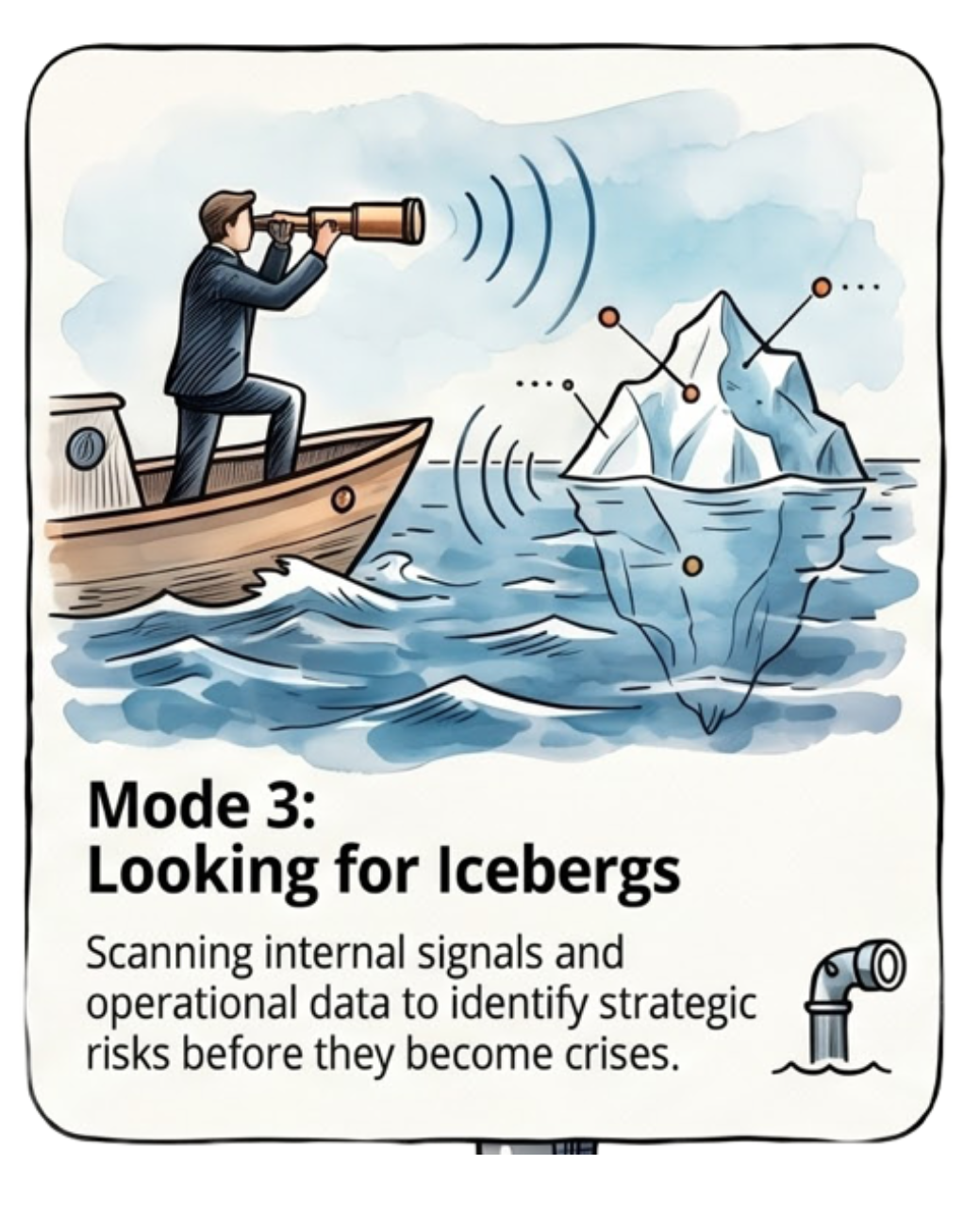
Continuous horizon scanning for emerging risk before it becomes crisis
A lagging indicator tells you what already happened; a leading indicator tells you what is about to happen while there is still time to act on it.
The failure here is capacity. Most departments understand horizon scanning; what they lack is the structural room to do it consistently.
The most actionable signals are often internal and already sitting in the operational record, where that record exists.
Tackling it means instrumenting leading indicators across the whole operating model and recovering the capacity needed to scan consistently.
Mode 4 of 4
Learning and Improvement
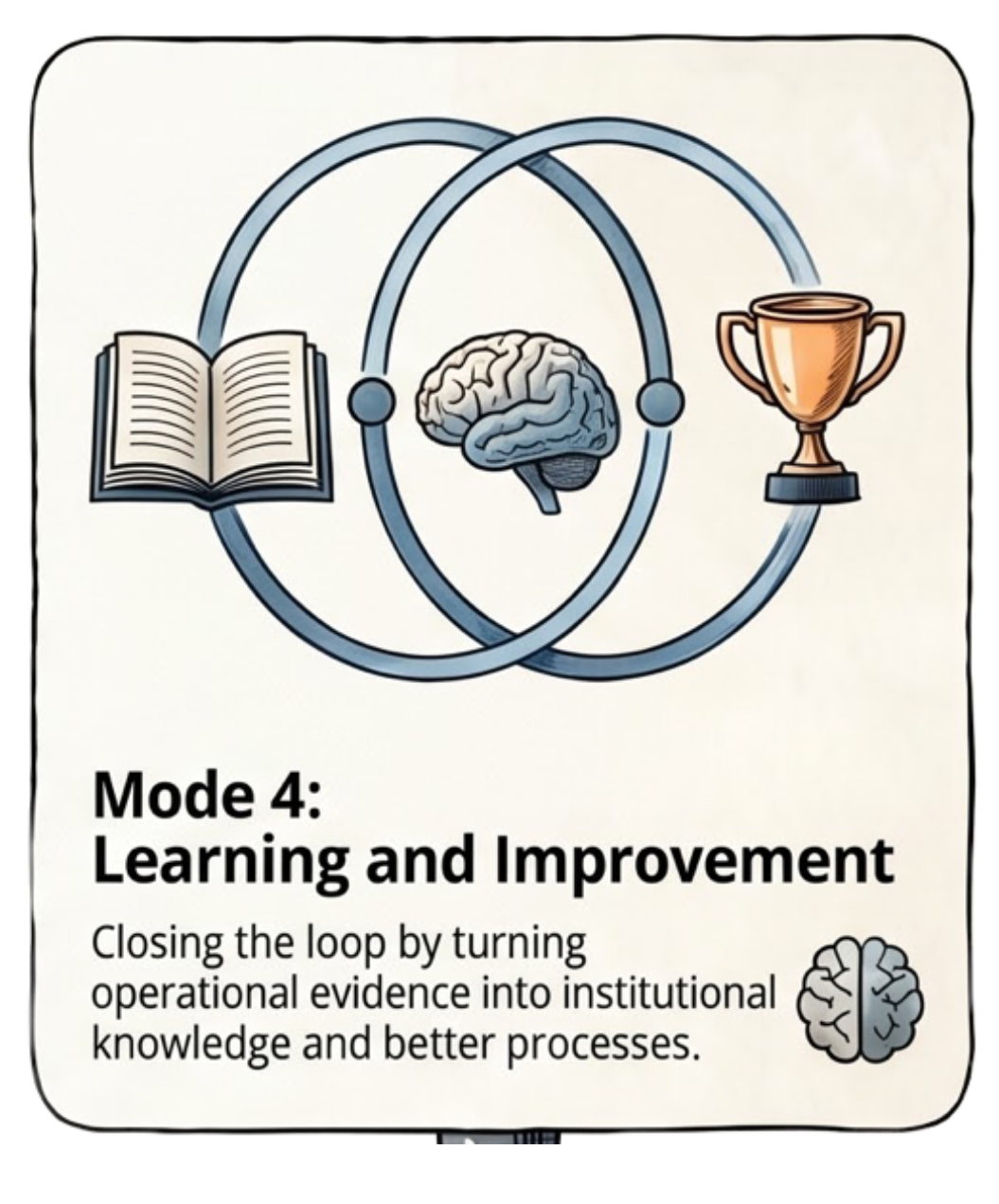
Closing the feedback loop: process refinement, stakeholder intelligence, and operational maturity
Friction in the operating model is a signal worth reading. It shows where the system needs to adjust.
Tackling it means generating feedback as a byproduct of running the work, so it does not depend on a separate survey no one has time for.
Most departments have no designed mechanism for learning from their own operations, so improvement happens by accident when someone with enough standing forces the question.
The deeper problem is that lawyers apply to operational problems the same instincts that serve them in practice: precedent-bound, skeptical of new information, and slow to revise a settled position.
Where a department actually starts
The four issues are connected, and the order is not arbitrary. Business As Usual comes first, because the visibility and recovered capacity it produces are what make the other three possible.
The starting move is to make the work visible and separate judgment from overhead at the front door, then track the handful of vital signs the work now generates, then take one workflow, run it, read what the improvement data returns, and refine it.
References
| Source | What it contributes |
|---|---|
| Foundation Series, Paper I: The Quiet Crisis | The doom loop: six self-reinforcing conditions, beginning with volume and scope arriving faster than the operating model can absorb. |
| Foundation Series, Paper II: Seeing the System | The enterprise view, relationship vital signs, second-order effects, and four starting practices. |
| Foundation Series, Paper III: The Wrong Verdict | The External Pressures behind legal’s undeserved reputation. |
| Foundation Series, Paper IV: Beyond Endurance | Heroic systems, resilience, the OODA loop, operational vital signs, and friction as signal. |