

FOR IN-HOUSE LEGAL TEAMS
The Legal Operating Layer
for NetDocuments
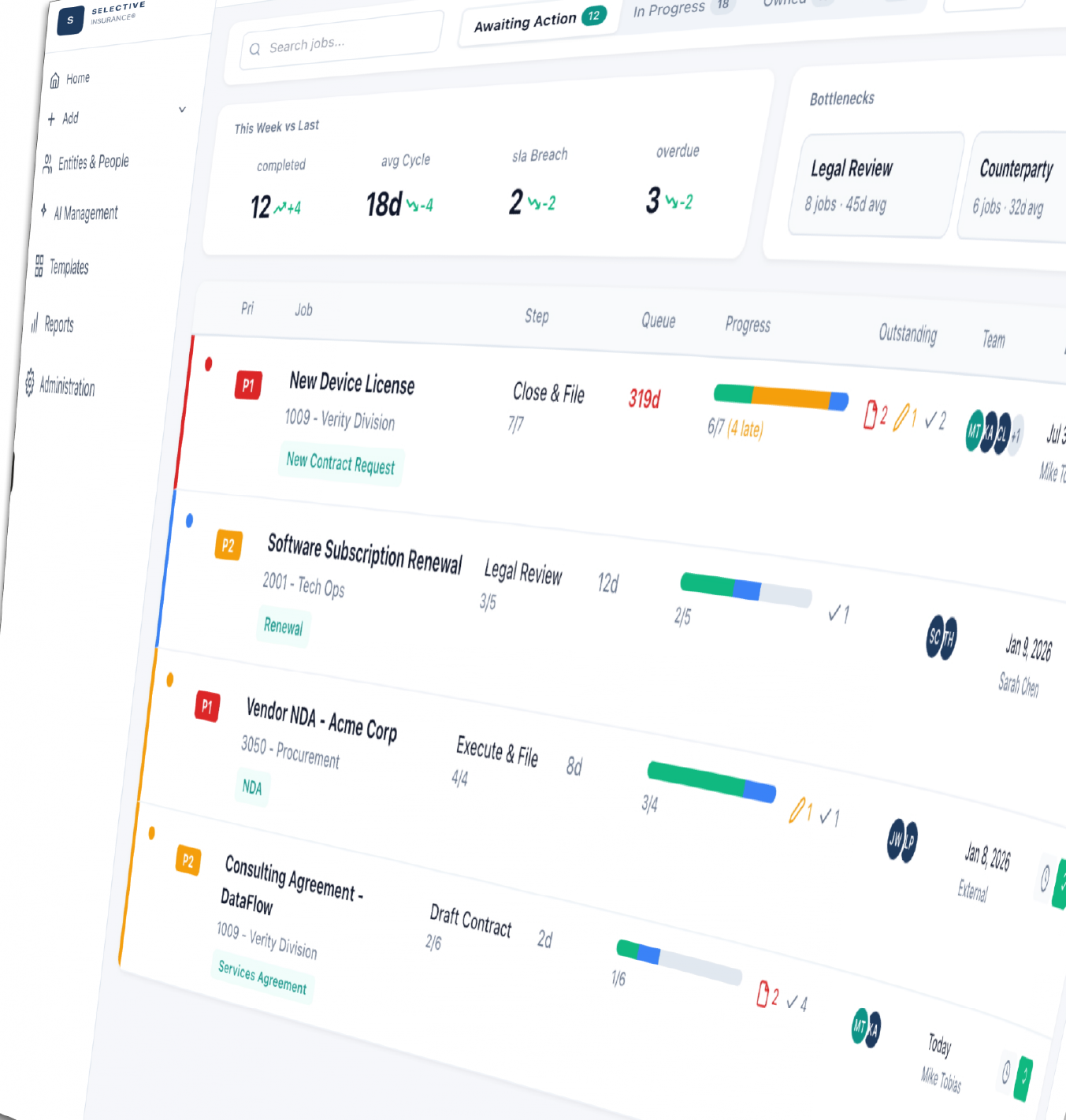
Not another ELM or CLM. mot-r is the operating layer that gives your legal team its own front door and runs the work behind it, start to finish: every request, contract, matter and advisory engagement, managed and tracked until it's actually done.
The result: less admin burying your best lawyers, fewer requests routed around Legal, and visibility into exactly where work stalls.
One adaptable system, configured by Legal Ops. Prove it on one of your real workflows in 60 days, before you make a broader commitment.
Management Wants versus Legal Needs
What management wants
Management sees Legal as a cost center. They want better service, faster turnaround and clearer visibility, without proportional increases in headcount or spend.
What Legal needs
Your Legal team is already stretched. More demands without more support means longer hours, mounting backlogs, and eventually burnout and turnover.
Satisfy Both
The bottleneck isn't your people. It's operational friction: status-chasing emails, disconnected tools, manual tracking and unclear priorities. Fix the friction and you unlock capacity that's already there.
mot-r is the operating layer that aligns demand, capacity and execution, working directly with the documents already secured in NetDocuments. One platform for intake, tracking, workflows and reporting, configured by Legal Ops, not IT.
The Documents Are Centralized. The Operation Surrounding Them Isn't.
NetDocuments keeps Legal's documents secure, organized and authoritative. But the work around those documents (who asked for it, who owns it, what was decided and what's still waiting) usually lives in email, spreadsheets and memory.
The DMS preserves the documentary record. mot-r preserves the operational record.
NetDocuments answers
- Where is the document?
- What version is authoritative?
- Who can access it?
mot-r answers
- Why was the work initiated?
- Who was responsible?
- What was decided, and under whose authority?
- What risk was identified?
- What changed, and what happened next?
Working alongside NetDocuments, not against it
Documents stay in NetDocuments. mot-r manages the work around them, and can span multiple repositories at once, so changing or adding a document system never means changing the way Legal operates.
Where Other Approaches Fall Short in a NetDocuments Environment
ELM and CLM suites
Workflow gaps, and documents duplicated outside the DMS.
Point intake tools
Requests are captured, but nothing coordinates the work that follows.
Acquired tool stacks
Disconnected modules held together by fragile integrations.
Power Automate and SharePoint forms
Brittle internal builds that are hard to change as the business does.
Two Wins. One Platform.
When legal work is coordinated around the documents already secured in NetDocuments, both management and Legal win.
Management gets visibility and throughput
- 450 hours a year recovered per team
- $2.5M+ typical five-year savings
- Real-time visibility into workload, status and throughput
- Faster response times without adding headcount
Legal gets clarity and sustainable workloads
- One record for every matter and task
- Fewer interruptions, with no more status-chasing
- Clear priorities, so the right work gets done first
- A sustainable workload that reduces burnout
Where mot-r Excels
No 12-month implementation
Start with one workflow. See results in weeks.
No IT dependency
Legal Ops configures directly, and adapts as fast as your organization changes.
One product, built as one
mot-r has had one cohesive product team since day one, not a suite assembled through acquisitions. A unified code base delivers seamless integration of functions, security and data.
No vendor lock-in
Our standard contract includes a Termination for Convenience upon Change of Control clause. If mot-r is ever acquired, you're not trapped.
Insights for Legal Ops Leaders
Short reads and research for Legal Ops leaders focused on visibility, efficiency, and reducing burnout.



What mot-r Covers
The capabilities you'd expect from ELM, run as one coordinated operation.
Self-service requests
The business asks for help in one place, with the details Legal needs.
Intake and triage
Requests arrive complete and reach the right people.
Workflows
Multi-step work stays coordinated across teams and stakeholders.
Reporting
Live views of demand, capacity, cycle time and performance.
Contracts
Drafting, negotiation, execution and renewal in one process.
Matters
Every matter visible from open to close.
Spend
Legal spend tracked alongside the work it relates to.
Outside counsel
Relationships and performance managed in the same place.
Are We the Right Fit?
mot-r is the right fit if
- You need ELM capabilities but don't have time for a 12 to 18 month implementation
- You don't have dedicated IT support for Legal
- You want to prove value before making a significant commitment
- You've been burned by legal tech that didn't deliver
- You're wary of PE-backed vendors and their incentives
- You need a platform that adapts as your organization changes
- You're interested in AI but want to adopt it on your own timeline
We're probably not the right fit if
- You're looking for a narrow point solution rather than a platform
- You have robust IT dedicated to Legal and prefer that model
- You need a vendor your board has heard of, even if it's not the best fit
That's okay. We'd rather know now than waste each other's time.
AI-Ready When You Are
GenAI will change legal work. It also brings real risks to competence, confidentiality and supervision. Most vendors are racing to ship AI features. We took a different approach.
Our Lawyer-in-the-Loop (LITL) AI is additive, not mandatory. Your workflows run without AI. When you're ready, AI enhances them with no rebuild required. Use the AI you choose, change models as the market evolves, and govern it through the way Legal already works: human oversight, approvals and a full audit trail. Documents stay in NetDocuments.
Prove it in 60 Days.
Choose one of your real workflows. We'll configure it with your people and processes and agree in advance how success will be measured: cycle time, work in progress, stale work and first response time. Judge the evidence before you make a broader commitment. Expand from there only if it makes sense.