


Welcome to Legal Ops Briefs—inspired by the mot-r mindset, this blog series of 3-minute reads gives in-house Legal Ops quick, operational insights. Each post will explore the tech, trends, and tactics that boost operational effectiveness and ease legal team stress—without adding to the noise.
In 1961, an American operations researcher named John Little published a short paper in the journal Operations Research with an austere title: "A Proof for the Queuing Formula: L = λW." It was five pages long. What it established has become one of the most durable findings in operations science.
The equation says that the average number of items in a system (L) equals the average rate at which items arrive (λ) multiplied by the average time each item spends in the system (W). In plain language: the work piled up in front of you equals how fast it is arriving times how long it takes to get through. Translated to a legal department: the work in your queue equals your intake rate times your cycle time.
What made Little's paper consequential was the proof. The relationship holds without assumptions about how arrivals are distributed, how many people are processing the work, or what order they handle it in. Whether you are looking at a call center, a manufacturing line, a hospital triage unit, or a contracts inbox, the math does not care. If the system is stable, L = λW.
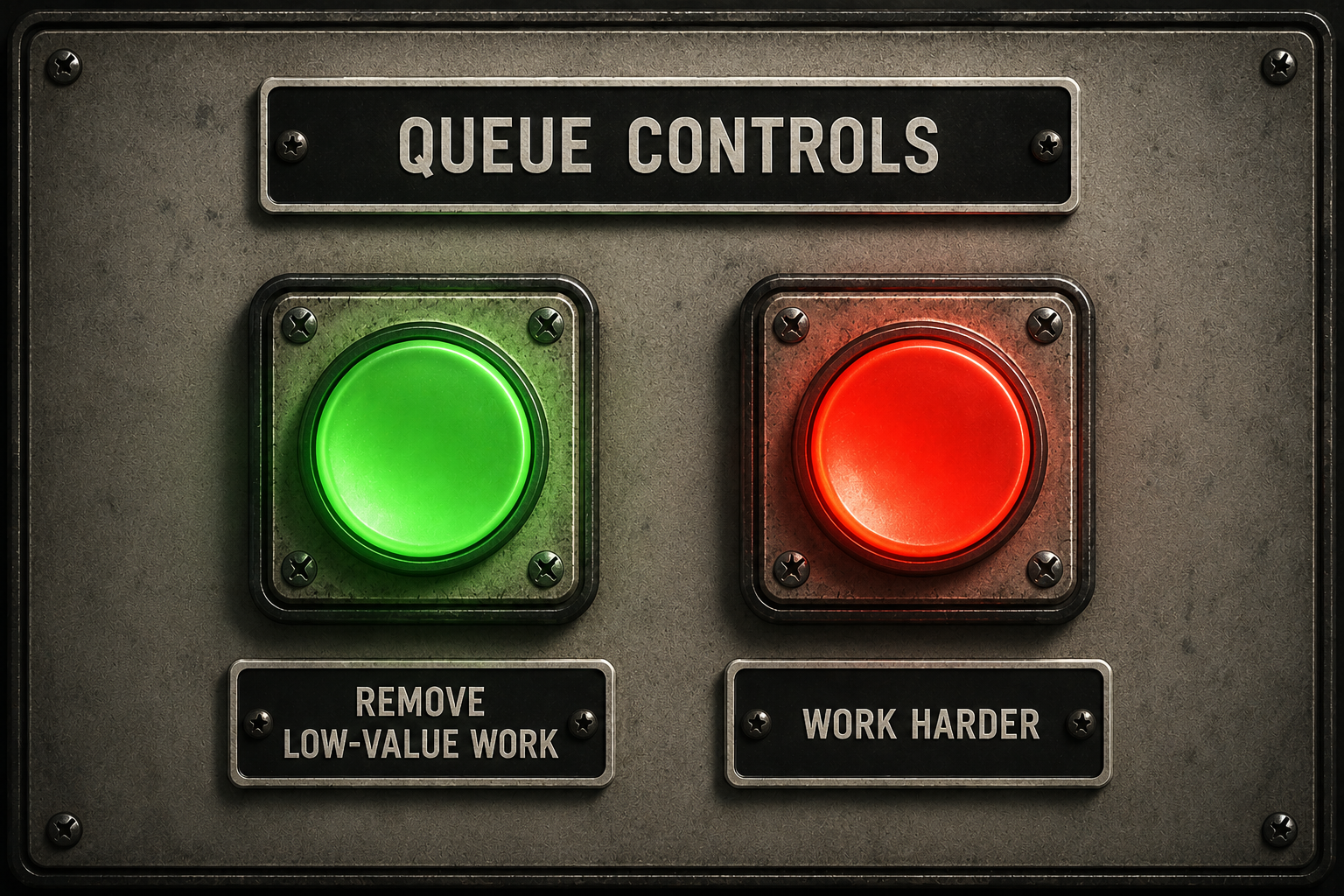
The equation gives a legal department exactly two levers for shortening the time work spends in the system. You can raise throughput, or you can reduce what is in the queue. Most departments only pull the first one. The conventional response to a swelling backlog is to push on throughput by hiring more lawyers, working them harder, adding hours. The result is what the equation predicts. If intake keeps growing and cycle time stays high, the team produces more and still drowns, because L keeps climbing.
The less-used lever is reducing what is in the system in the first place. This is the more interesting question, and the one most legal departments have never seriously asked. What work is sitting in the queue that should not be there at all? Which matters return again and again because the team is being asked to do work it is genuinely bad at, or work that no longer serves the business, or work that has been routed through legal by reflex rather than by design? Which standing meetings, status reports, and procedural reviews exist because they once mattered to someone who is no longer in the room? Each of those items is contributing to L. Removing one of them does to cycle time what adding a person cannot.
The discipline of identifying low-value work and stopping it has been developed seriously elsewhere. The Institute for Healthcare Improvement has built it into its operating practice over two decades through the Joy in Work framework and the related Breaking the Rules exercise. Dan Heath's recent book Reset names the same lever in general management terms with two of its central plays, Recycle Waste and Do Less and Do More. The discipline is not novel. It has just not been applied to in-house legal with the same rigor.
The relationship between L and W is also a relationship between operating conditions and human experience. A team carrying twice the work in progress its capacity supports will, by the equation, experience roughly twice the time to completion on every matter, twice the queue of unresolved questions at the end of the day, twice the friction in conversations with the business. The exhaustion that follows is what the equation predicts. The variables have not been examined.
John Little spent more than sixty years on the MIT Sloan faculty and died in 2024 at the age of ninety-six. The paper he published in 1961 described the floor of every operations conversation that has happened since. For a legal department that suspects it is working harder than the math should require, the most useful thing the law offers is a question that costs nothing to ask. What is actually in our system right now, and how much of it should be?
Chime In. Be Heard.
The question of what belongs in the queue and what does not is one most legal departments have never formally asked. If yours has, or if you have a perspective on why that conversation is so hard to start, share your thoughts and insights. The in-house legal community will be better for it.
SOURCES
John D. C. Little, “A Proof for the Queuing Formula: L = λW,” Operations Research 9, no. 3 (June 1961): 383–387. John D. C. Little, “OR FORUM — Little’s Law as Viewed on Its 50th Anniversary,” Operations Research 59, no. 3 (2011). Massachusetts Institute of Technology, Institute Professor Emeritus John D. C. Little obituary (October 2024). Jessica Perlo et al., IHI Framework for Improving Joy in Work, IHI White Paper (Institute for Healthcare Improvement, 2017). Dan Heath, Reset: How to Change What’s Not Working (Avid Reader Press, 2025).
mot-r is the Legal Operating Layer for modern Legal Ops teams. Unlike traditional ELMs, CLM tools, or disconnected point solutions, mot-r provides a low-risk way to resolve the structural causes of legal overload—not just track matters after the fact. By bringing structure to legal intake and visibility to execution, mot-r helps legal teams improve service quality, regain capacity, and reduce burnout. The result is better decisions, higher-value legal service, and an operating model teams can sustain as demand grows.
