

The Saturday That Starts at 7:11

Welcome to Legal Ops Briefs—inspired by the mot-r mindset, this blog series of 3-minute reads gives in-house Legal Ops quick, operational insights. Each post will explore the tech, trends, and tactics that boost operational effectiveness and ease legal team stress—without adding to the noise.
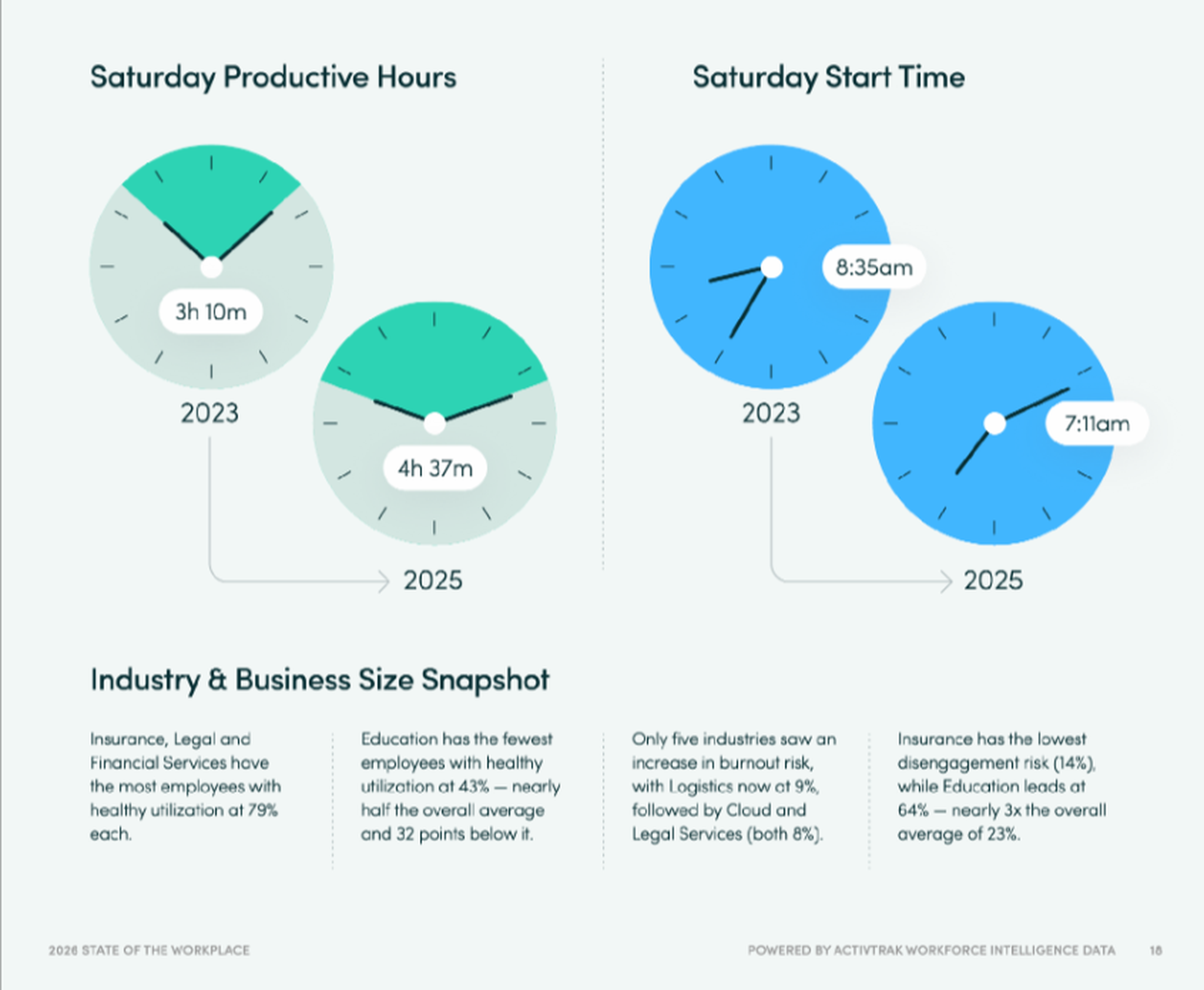
ActivTrak’s 2026 State of the Workplace report tracks three years of behavioral data across 1,111 organizations and 163,638 employees. The weekend numbers are concerning.
• Saturday productive hours: 3h 10m → 4h 37m (+46%)
• Sunday productive hours: 2h 30m → 3h 58m (+58%)
• Saturday start time: 8:35 a.m. → 7:11 a.m.
• Sunday start time: 12:24 p.m. → 10:58 a.m.
Three years of data, every measure trending in the wrong direction. You might be tempted to think of this as a sign of ambition or a few outliers distorting the average. The dataset rules that out. When weekend behavior shifts this consistently across this many people for this long, the cause is structural.
The legal data tells the same story:
• 59% of CLOs report increased workload, and only 20% of those with significant increases are happy with their work-life balance (ACC 2024)
• 83% of legal departments expect demand to keep rising (Harbor/CLOC)
• GCs expect workloads to grow 25% in three years against expected headcount growth of 3% (EY Law / Harvard Law School)
• 87% of in-house counsel report spending too much time on work that does not require their training (EY Law / Harvard Law School)
Too much work and not enough hours. Axiom’s View from the Inside survey asked legal teams to name the top sources of tension with in-house leadership:
• 39% Lack of communication and collaboration
• 36% Adoption of technology
• 35% Misaligned priorities and objectives
• 31% Misalignment of performance metrics and KPIs
• 31% Allocation of resources (budget, personnel, technology)
• 28% Lack of defined roles and responsibilities
So, not only too much work, but inadequate operating conditions to get the right work done. The work that doesn’t get finished during the week (and nights) is increasingly leaking into Saturday.
The suffering this causes is clear, and the burnout, retention, and disengagement data across the profession confirm it. Reading it as a personal productivity problem is incorrect. Every system is perfectly designed to get the results it gets. The Saturday hours are merely a symptom. Change is required in the system, not the individual: in capacity, in tooling, in roles, and in the daily operating practices that decide what gets handled when. Read that way, the 7:11 Saturday is useful. The system is telling you, plainly, that the weekday no longer fits the work.
Chime In. Be Heard.
Legal Ops professionals see this shift happening in real time—work expanding beyond the workweek, demand outpacing capacity, and systems struggling to keep up. Where are you seeing the pressure show up first in your organization? Is it weekend spillover, misaligned priorities, or time lost on work that shouldn’t require legal expertise? Your perspective matters. Sharing what’s actually happening on the ground—what’s breaking, what’s working, and what needs to change—helps the broader Legal Ops community move toward better, more sustainable ways of working.
SOURCES
ActivTrak Productivity Lab, 2026 State of the Workplace Report (March 2026). ACC Chief Legal Officers Survey 2024. Harbor/CLOC Legal Department Operations Survey. EY Law and Harvard Law School Center on the Legal Profession, General Counsel Imperative Series (2021). Axiom, View from the Inside Survey.
mot-r is the Legal Operating Layer for modern Legal Ops teams. Unlike traditional ELMs, CLM tools, or disconnected point solutions, mot-r provides a low-risk way to resolve the structural causes of legal overload—not just track matters after the fact. By bringing structure to legal intake and visibility to execution, mot-r helps legal teams improve service quality, regain capacity, and reduce burnout. The result is better decisions, higher-value legal service, and an operating model teams can sustain as demand grows.
