

mot-r Foundation Series
May 2026
Beyond Endurance
What Resilient Legal Operations Actually Require
The endurance keeping your legal department afloat is the very thing preventing anyone from fixing it.
This whitepaper is for General Counsel and Legal Ops leaders who can no longer ask their people to absorb more.
"You can't compare Legal to other departments. Legal is unique."
We've all heard this. We may have even said it. Legal departments are snowflakes. Each one a perfectly formed, unique, beautiful structure. The department doesn't operate the way other departments do. Lawyers don't operate like other employees. Their work is unlike that of any other department.
They are highly educated and highly skilled. They are critical protectors of the long-term viability of the enterprise. And they are the most disliked, disrespected, and dismissed department in the company.
Yet they keep showing up. They keep fighting the good fight, taking on heavier and heavier workloads while their reputations get impugned.
Section 1 — The Misreading of Endurance
Success does not lie in sticking to things. It lies in picking the right thing to stick to and quitting the rest.
— Annie Duke, Quit (2022), Prologue
Every system is perfectly designed to get the results it gets. In Paper I we introduced the doom loop, the system lawyers and legal operations people work inside. However hard they try, it keeps producing the same things, overwork, damaged
reputations, and burnout for the people in it.
Paper I also introduced you to Dr. Larry Richard, who has profiled more than 25,000 lawyers over three decades with validated psychometric instruments. Among the ways lawyers differ from the general population, one matters most here. They score below the 50th percentile on resilience, which measures sensitivity to criticism and how well someone recovers from interpersonal setbacks.
The doom loop's conditions seem almost tailor-made to wound lawyers. They have grit and perseverance in abundance, so they push harder to meet the demands, and then take the criticism the system throws off personally. That feeds record levels of job dissatisfaction, burnout, and attrition, which piles still more work on the people who stay.
The endurance shown by the remaining team members is equal parts admirable and misread.
The right reading exists. It has been around for decades, in fields a long way from legal practice, and the evidence lines up across more than sixty years. Peter Drucker named the principle in 1999. The first question for any knowledge-work organization is what to eliminate, the activity that gets in the way of the task and should be stopped. Productivity in knowledge work is mostly a matter of getting the
wrong work out of the way of the right work. Astro Teller built that principle into operations at Google X. His Moonshot Factory pays people bonuses for killing their own projects. Quitting is rewarded because the principle demands it. If you can't stop the wrong work, you can't do the right work.
Annie Duke explains why most organizations don't do what Drucker named and Teller built. Grit gets celebrated, quitting gets stigmatized, and that asymmetry traps people and organizations in losing positions long after the losses are obvious. John Little, at MIT in 1961, gave the same answer in math. Little's Law says the amount of work in any stable system equals the rate work arrives multiplied by the time it spends in the system (L = λW). Don't drop the work that doesn't belong and your cycle times get worse. The math doesn't care about grit.
Six decades of evidence, from knowledge-work productivity to moonshot R&D to behavioral decision science to queueing theory, point to the same thing the legal profession hasn't taken on board. The principles, the structures, the psychology, and the math that govern knowledge work apply to corporate legal departments too. There is no credible evidence otherwise. What there is, instead, is a profession that hasn't held its operations to the evidentiary standard it holds its legal work to. It has leaned on endurance in place of the structural work the principles call for.
Section 2 — The Limits of Heroic Systems
Conscientious high performers are the ones who struggle the most while keeping everything afloat. The paralegal who runs the "master" spreadsheet. The legal ops manager who cuts and pastes data from an ERP system every day to ensure matter records are correct and the team can catalogue their documents properly. The senior commercial lawyer who has become the unofficial escalation path for every difficult deal. They are often the first at work and the last to stop, until they don't.
When one of them finally burns out, quits, or goes out for an extended stretch, the whole thing comes apart. Nobody else knows where the data comes from, where it goes, or how to keep the definitive sources current. The single point of failure that was always there is suddenly in plain view.
The typical response is that someone else steps up to assume the task, taking on work that shouldn't have been done in the first place and increasing their own workload and dissatisfaction.
Leadership doesn't notice the change in workload. The new paralegal manages the spreadsheet, the matters still get tracked, and the deadlines still get met. The system appears to be working because there are no gaps in delivery. What leadership doesn't see is the hidden cost of the transfer, the burden on the people producing it, and the structural investment that never happens because the problem never surfaces.
The Axiom data quantifies the harm. More than half of in-house lawyers are actively searching for a new position or open to one. The heroic systems are relying on people who are already preparing to leave. The dependency holds together until one of them goes.
That is how heroic systems fail. They keep themselves alive because the work they produce hides the need for the investment that would replace them. Pfeffer and Sutton put facing the hard facts, even the unpleasant ones, at the top of evidence-based management. The hard fact here is that nobody fixes a heroic system, because from the outside it doesn't look broken.
Section 3 — Robustness vs Resilience
Nassim Nicholas Taleb, who we met in Paper III, lays out a continuum that applies here. If you are going to replace heroic systems with evidence-based ones, you have to ask how well the replacements hold up under stress. Fragile systems degrade under it. Robust systems absorb it and stay as they were. Antifragile systems actually gain from it, and they need it to build the capacity for whatever comes next.
Most legal departments sit at the fragile end. The usual goal, when there is one, is robustness, a department that can take the pressure without breaking. Robustness isn't enough. Legal environments shift too much for a static operating model, however well that model resists stress.
Wherever the company hits volatility, legal hits it too. Regulations change, technology advances, market boundaries collapse, companies acquire and divest. All of it lands on legal.
Any discussion about resilience in legal departments is focused on personal qualities, the associate who handles the increasing workload, the general counsel who remains composed under board scrutiny, or the team that absorbs the absence of others without complaint. None of this is operational resilience. Operational resilience is a property of the system, and not the individual. It is built
into how work is assigned, how teams are supported, and how stress is detected and absorbed. When resilience is treated as personal, the burden falls on the people inside the system. When it is treated as structural, the burden falls on the system that surrounds them.
A resilient system has to sense and respond continuously. It takes in what is actually happening, makes sense of it against an accurate operational picture of the business, decides what to change, acts, reads the result, and begins again. The cycle has to be continuous, because change and learning are continuous.
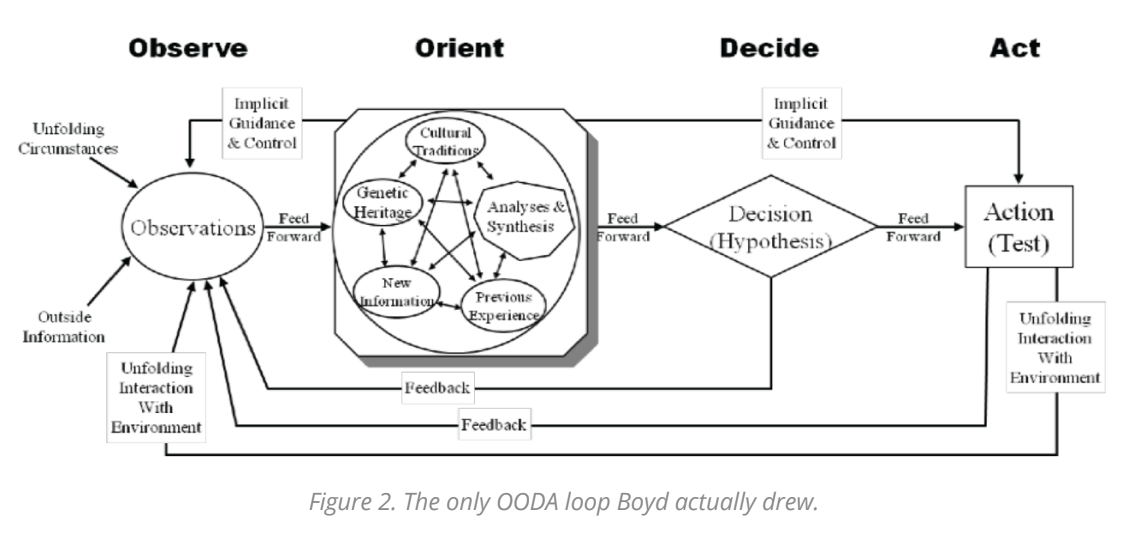
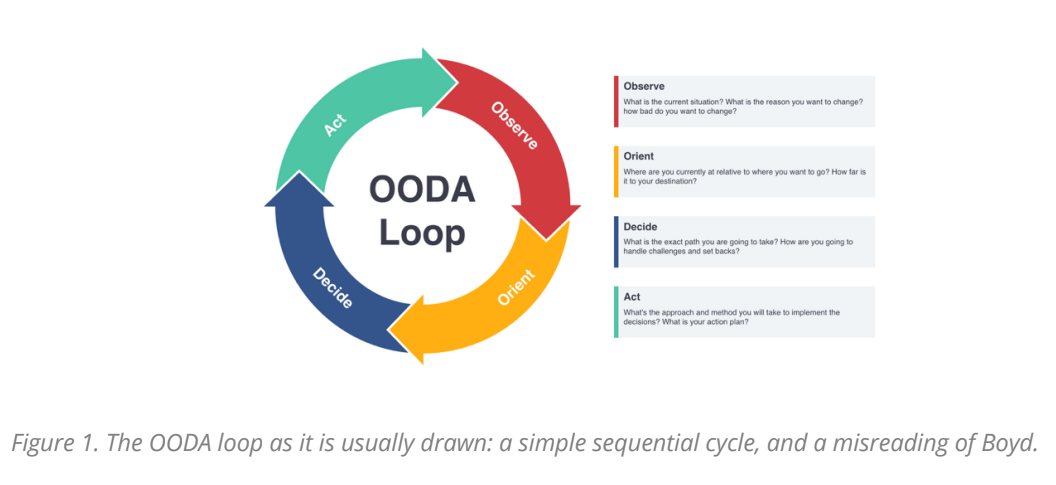
This cycle is called the OODA loop. John Boyd, a fighter pilot and military strategist, coined it to represent a cycle of observe, orient, decide, and act. The common interpretation referred to in business writing treats it as four steps to be run as fast as possible. That isn’t what Boyd’s teaching was about. The advantage comes from keeping your operational picture accurate, and from sharing it so the people around you can act on it without waiting to be told.
The visualization typically used to represent the loop is equally misleading. Boyd drew orient at the center, larger than the other three stages. Feedback runs both forward and backward through the whole system. Orient is where cultural traditions, prior experience, and new information are analyzed and synthesized into a working picture, and the quality of that picture governs everything downstream.
Section 4 — Operational Vital Signs
You can't manage what you can't see. Evidence-based practice runs on fact-based decisions. The question is which facts to put in front of you. Finance has a pair of concepts worth borrowing. Lagging indicators and leading indicators. A lagging indicator tells you what already happened. A leading indicator tells you what is about to happen, while there is still time to do something about it. Think of the rearview mirror against the windshield.
The worst problem with lagging indicators is what they do to incentives. Jeremy Hope and Robin Fraser, whose Beyond Budgeting work named this, saw that once an organization measures success by hitting a number, people hit the number and let the organization's actual health pay for it. The sales team pushes a high-risk contract through to make Q4 quota. The exposure shows up in year three, by which point the regime that rewarded the behavior has collected its bonus and moved on. This is the operational version of the lollapalooza effect Paper III traced. Capital markets reward short-term predictability, and lagging indicators push that pressure down into the daily behavior that builds legal's tail-risk.
As the velocity of change has accelerated, finance recognized that relying on lagging indicators is a version of Taleb's "Thanksgiving Turkey Problem": the turkey is fed and cared for every day, which tells it nothing about the impending Thanksgiving.
Ten great quarters of EBITDA don't mean the company is healthy. Leading indicators let finance catch friction early and hedge against the extremes before they reach the P&L.
Legal is still running like a finance department from the 1990s. When it reports to the board, the numbers are always the same, total outside spend, contracts executed, settlement payouts. None of them tell leadership anything about the current risk profile or the health of the function.
Paper II named four vital signs that give early warning. First response time, volume change by client unit, legal response time against client response time, and client satisfaction. More come from inside the operating model itself, intake rate, cycle time, work-in-process by practice area, stale and overdue work, and team attrition.
| Vital Sign | What It Detects | Why It Matters |
|---|---|---|
| First response time | Delay before acknowledgment | Early client frustration |
| Volume change by client unit | Routing behavior changes | Potential bypass risk |
| Legal vs client response time | Bottleneck location | Reveals actual constraint |
| Intake rate | Demand pressure | Capacity imbalance |
| Cycle time | Workflow duration | Flow efficiency |
| Work-in-process by practice area | Concentrated overload | Hidden migration of stress |
| Stale or overdue work | Emerging backlog | Crisis formation |
| Client satisfaction | Relationship quality | Reputation risk |
| Team attrition | System fragility | Loss of operational resilience |
These signs only diagnose anything as a set, and only when they cover the whole operating model. Track first response time for contracts and leave regulatory unmeasured, and you learn something about contracts. You learn nothing about whether stress is moving from one part of the function to another, which is the question that matters. Detection needs breadth, and legal runs across a wider spectrum than most departments.
WIP, intake rate, and cycle time aren't independent measures. Little's Law ties them together as three sides of one equation, where knowing two gives you the third. Track all three and the function can see whether its operating model is in balance.
Finance changed because the speed of business forced it to. Legal faces the same pressure now.
Section 5 — Friction as Signal
Be hard on the process, not the people.
Paper III made this point from the outside. What gets called friction is the network doing its job. The same holds from inside the operating model. The friction legal runs into in its own operations is signal, not failure.
Resilient systems need stressors to evolve. Friction from the business is a leading indicator, a read on where the system needs to adjust. Bottlenecks, delays, and overload are the diagnostic signals it gives off.
When operational friction surfaces, ask what the system is trying to teach you. Who is responsible comes later, if it comes up at all. Part of the answer is instrumentation. The harder part is cultural, moving from assigning blame to thinking in systems. Without that change, adaptive operations never take hold.
How are you supposed to free up time and resources for change when everyone is already overloaded? You go back to Drucker, Teller, and Little. Stop the activities that get in the way of the task, kill the projects that aren't producing, and pull down work-in-process to free up cycle time. You don't add capacity for change to the operating model. You create it by taking out what shouldn't have been there in the first place.
Section 6 — Compounding Returns on People Investments
"The purpose of an organization is to enable ordinary human beings to do extraordinary things.
No organization can depend on genius; the supply is always scarce and always unpredictable.
It is the test of an organization to make ordinary people perform better than they seem capable
of, to bring out whatever strength there is in its members, and to use each person's strength to
help all the other members perform."
— Peter Drucker, Management: Tasks, Responsibilities, Practices (1973)
Peter Drucker, the father of modern management, coined the term "knowledge worker" for employees whose value is their expertise rather than their physical labor. His argument was that management's job is to build the systems that get the most out of that expertise. Management theory before him was about the factory floor and manual labor, how to make a worker shovel coal faster. You cannot manage a knowledge worker that way. You build systems that put their intellect to work and clear the administrative friction out of the way.
In his 1999 book, Management Challenges for the 21st Century, Drucker put it this way: "one does not 'manage' people. The task is to lead people. And the goal is to make productive the specific strengths and knowledge of each individual." Knowledge workers differ from factory workers in a basic way. They own the "means of production."
Around the same time, McKinsey introduced the "War for Talent" model. It ran on pedigree, on drawing a sharp line between top performers and everyone else, and on a "star" culture that put individual genius above all of it. It gave intellectual cover to "rank-and-yank," the practice of forcing the bottom 10% out every year. Writing as Enron collapsed in 2001, Jeffrey Pfeffer named the mechanism in Fighting the War for Talent is Hazardous to Your Organization's Health. The model bred an arrogance that went around process, it rewarded information hoarding through zero-sum competition, and it shielded the designated stars from accountability. Enron, whose CEO Jeffrey Skilling was a former McKinsey partner, was the model's fullest expression and its most spectacular failure. Its stars got to skip compliance and legal protocols because the culture said you don't question the talent. The parallel to legal is direct. The profession lionizes the lone genius over team-based systems, and the "rockstar" attorney is the same star instinct Pfeffer named at Enron.
McKinsey's instinct was right. People matter. The frame was wrong. Their talent frame depends on finding and keeping the exceptional. Lean entirely on stars and institutional transparency disappears, the risk lives in their inboxes and their heads instead of being visible to the organization. Drucker's frame builds systems where ordinary people become effective.
Jeffrey Pfeffer and Robert Sutton frame the leadership task in their 2006 book Hard Facts, Dangerous Half-Truths, & Total Nonsense: "Perhaps the best way to view leadership is as the task of architecting organizational systems, teams, and cultures – as establishing the conditions and preconditions for others to succeed." The work of legal operations is to put fewer things in the way of the work lawyers are trained for, and to amplify what is already working.
The work is structural: decisions about scheduling, communication, status meetings, and which windows of the day are protected from the frenzy. Edward Hallowell described this in his 2005 Harvard Business Review article "Overloaded Circuits: Why Smart People Underperform" as a focus deficit produced by the environment, one that goes away when the environment changes. Gloria Mark's UC Irvine research found it takes 23 minutes and 15 seconds to resume a task after an interruption. ActivTrak’s 2026 State of the Workplace, built from 443 million hours of monitored work activity, put the average uninterrupted session at 13 minutes and 7 seconds by 2025. The two come from different measures, so the comparison is directional rather than exact, but the gap runs one way: focused stretches are now shorter than the recovery they require. The environment is designable. Without that design, lawyers absorb the cost privately.
Teresa Amabile and Steven Kramer studied nearly 12,000 daily diary entries from 238 knowledge workers and found that making visible progress on meaningful work is the strongest driver of a good day at work. When people can't see progress on the work they trained for, satisfaction erodes.
High-quality legal service takes uninterrupted time on high-value work, given to the right people. Everything else you put in their way erodes the service and the productivity of the people producing it.
Removing what burdens your people is one side of it. The other side, which Papers I and II drew from Batalden and the IHI Framework for Improving Joy in Work (2017), is finding out what matters to people, clearing the impediments with them rather than for them, and iterating on it steadily.
Compound the returns on those people investments and you start to counteract the negative flywheel of the doom loop. Investment in the right conditions builds capability, protects time, deepens engagement, and improves retention, and those compound into the institutional strength of a positive flywheel, the kind that produces extraordinary work.
Section 7 — Adaptive Operation Under Uncertainty
"It ain't what you don't know that gets you into trouble. It's what you know for sure that just ain't so."
— Misattributed to Mark Twain
For decades, the legal industry has “known for sure” that the only way to handle rising volume and risk is to lean on heroic individual endurance. That certainty is what is taking the function apart.
In Paper I we outlined how the legal department was caught in a doom loop, a negative flywheel of connected conditions that together create outcomes that exhaust even the hardiest of legal professionals. Despite the widespread acceptance of the problems individually, there has been no recognition of the connection and self-reinforcing nature of these conditions as a system.
Paper II widened the view to take in the whole enterprise. As long as the doom loop runs, internal clients will first criticize the department and then route around it, and legal has no way to change that story, or even defend itself, because it has no measures or data to point to.
With Paper III we stepped back further and drew the line from market dysfunction through the enterprise and down to legal. Short-termism, toxic incentives, frenetic operating conditions, and the gap between legal and the business all push more pressure onto legal, while management smooths over the short-term bumps and loads the risk into the tail. None of it started with legal, and most of it is not legal's to fix.
This Paper IV brings us back to the individual, where people meet all of these forces by working harder and taking on more. Endurance has been the response, and it has been misread. Heroic systems move the load onto individuals and hide the structural problem, because the work still gets done. Robustness, the usual operational aim, isn't enough, because the operating conditions won't hold still long enough for any static model to work.
Across the four papers, the picture is a system that produces suffering, distorts reputations, pushes risk into the tail, falls short of the service and value the business expects, and resists fixing itself. Both sides, the enterprise and legal, have kept up the same fiction, that the individual is the unit of effectiveness. Knowledge work doesn't run that way. It needs shared infrastructure. Endurance was the only response on offer, and it wears people out without changing the conditions that cause the failure. What the department needs instead is a way to sense and respond. That means people, process, measures, and technology working together, so the department can operate under uncertainty without running on human endurance. Here is how you build it.
The reflex is to treat this as a project. Unfreeze the old way of working, change it, refreeze the new way, and move on. That is where the trouble starts, because there is no refreeze. The conditions don't stay put long enough for any fixed arrangement to stay right. Lock in this quarter's design and you've rebuilt the static system the doom loop runs on, already a revision behind reality the day it goes live.
It is also why the last few attempts faded. The reorganization, the platform rollout, the redesigned intake process were each designed, installed, and signed off, and each one met a system that kept moving underneath it. The gain was real for a while. Then the conditions shifted, the design stopped fitting them, and the same pressure showed up somewhere the project wasn't looking. They all failed for the same reason. Each was meant to be finished, and in this system nothing stays finished.
There's a reason you can't build the finished design in advance. You can't know how the people, the process, and the tools will behave together until they're actually running together. That interplay decides whether the design works, and it's the one thing no plan can see ahead of time. So the work is to run a version, watch how those pieces behave together, learn from what you see, adjust, and run the next version.
When you check into a hospital, the staff takes a handful of readings right away, things like temperature, heart rate, blood pressure, respiratory rate, oxygen, and pain level. No single one of them tells you much by itself. Put them together and you have a baseline for that patient, an early warning when something shifts, and a fast read on how urgently to step in and with what.
Medicine figured this out a long time ago. The corporate world, by and large, has not. As Jeffrey Pfeffer and Robert Sutton put it:
"In medicine, the evidence-based movement arose in response to thousands of deaths
and billions of wasted dollars that could have been averted by applying proven
practices. Similarly, in other fields, the growing pile of studies on the human and
financial costs of employee disengagement, management distrust, poor group
dynamics, faulty incentive schemes and other preventable damage suggests a need for
an evidence-based management movement."
— Jeffrey Pfeffer and Robert Sutton, "Trust the Evidence, Not Your Instincts," New York Times, September 3, 2011
Legal has its own vital signs, and they work the same way. They include time to first response on a client request, changes in the volume of requests and in who is sending them, cycle times, where the work backs up, how much each person is carrying, how the work turns out, client satisfaction, and attrition. Any one of them can mislead you. The set is what shows you where to look before something becomes a crisis.
None of this is easy in the early rounds. The useful data points can be hard to capture, and turning them into an accurate, complete picture is harder still.
The general counsel title is accurate. On most days, lawyers handle several areas of law, so the vital signs have to cover the full scope of their work, and the whole team's. A reading from one domain tells you nothing about the others. You wouldn't track a patient's health from their arm alone.
Most departments have systems and measures cobbled together over the years, and they tend to give a distorted or partial reading. Work and systems sit in silos, data takes time to surface and report, and there's little visibility into what has been done and what is underway right now.
Building work visibility is especially hard in legal, where operational structure can feel like an affront to professional expertise. That instinct isn't unique to lawyers. Surgery is at least as complex, and the stakes are higher, and it met the same resistance when it hit its own crisis of overload. It answered by building systems instead of asking surgeons to endure more. When Dr. Atul Gawande and the WHO introduced a 19-item surgical checklist, surgeons were skeptical at first, and many came around once they saw the results. Across eight hospitals in eight countries, complications fell from 11% to 7% and deaths from 1.5% to 0.8%. The checklist protected the surgeon's expertise instead of replacing it, taking the burden of routine recall off their plate so their attention could go to the surgery itself.
The hardest gap to close is the one with the outside. External signals are usually missing altogether. Even when a department does build feedback loops beyond its own walls, the team tends to reinforce its own confirmation bias, comparing notes internally and hearing mostly agreement. When people feel under siege, closing ranks around a shared story is a natural response. The second-order effect is that internal clients read that solidarity as the department being difficult or defensive.
What keeps the picture honest is unfiltered feedback from outside, and data that brings friction points to the surface. And those friction points are byproducts of the system, things you can fix, not failures of individuals.
Once you've captured useful, complete data, the hardest and most important work is making sense of it, because it can mean throwing out old mental models to make room for new ones.
Section 8 — Practice Is Not Delivery
"When the facts change, I change my mind. What do you do, sir?"
— Misattributed to John Maynard Keynes
Changing your mind sounds easy. Inside an in-house legal department, it rarely is. The trouble starts with a misread of where one kind of work ends and another begins, the line between the Practice Layer and the Operational Layer.
The Practice Layer is legal expertise applied. It's the demanding, bespoke work lawyers went to law school for, reading a regulatory shift, drafting a hard indemnity clause, negotiating an M&A deal, sizing up enterprise risk.
The Operational Layer is the delivery system around that work. It covers how a request comes in, gets triaged, routed, and tracked, and how the finished advice goes back out. The advice itself stays in the Practice Layer.
Back in 1983, the technology writer James Martin popularized CRUD, short for Create, Read, Update, and Delete, the four basic operations of stored data. A database stays accurate because it runs all four without playing favorites. It creates a record, reads it, updates it when the facts change, and deletes it when it goes stale. That's how software holds an accurate model of reality at any volume.
People don't run all four the same way. Create and Read come easily. We take in new information and pull up what we already know without much resistance. Update and Delete are where we balk, and the resistance has names. Updating means changing a belief when the facts change, and confirmation bias pulls the other way, toward whatever backs up the model we already hold. Deleting means letting go of something that has outlived its use, and loss aversion and the sunk-cost reflex keep us holding on well past the point where it helps. That's why changing your mind, which sounds simple, is so hard in practice. A database updates its model without a fight. We defend ours.
In the Practice Layer, rigidity is the point. The standard is zero defects. The method is to look backward, to precedent, to protect the future. Here, Dr. Larry Richard's findings on lawyers' high skepticism and autonomy are a real strength. You want a practitioner who is deeply skeptical of new information and slow to abandon a proven legal standard.
In the Operational Layer, rigidity is fatal. What it needs is to sense and respond continuously, which is the OODA loop. The method here is to look forward, to the vital signs, and adjust to volume and velocity. Here, that same skepticism toward new data, and that hard-won autonomy, will wreck the operation.
The structural failure of the modern legal department is that it runs the two layers together. Nothing in a lawyer's training tells them apart, so the approach that works in the Practice Layer, careful, precedent-bound, slow to change, gets applied to the Operational Layer by default. An intake form gets handled with the reverence owed to a court filing. The law and the mechanics of delivery never get separated, the orientation filter jams, and the friction lands on the individual lawyer.
From here the mechanics get easier. When the picture is accurate and shared, the right move is usually sitting there inside it, and a team that can see its own system doesn't have to reason its way to most decisions from scratch. What doesn't get easier is the discomfort, and it changes shape. It moves from seeing the system to acting on what you see before you can be sure it's right.
Section 9 — Build Through Small Experiments
The last two stages of the loop ask you to act before you can be sure. Deciding is forming a hypothesis about what will help. Acting is running it to find out. Both mean committing to a move when you can't know how it turns out, which cuts against the instincts the practice side of the work rewards.
So the rule for this part of the loop is simple. Treat it as a learning cycle, not a pass/fail gate. You clear or fail a gate, and a verdict comes with it. You run a cycle to learn, and a hypothesis that turns out wrong has still earned its keep by showing you something the picture couldn't. Put the rigor on the process, not on the people running it. Held that way, being wrong stops being a verdict and becomes information, and that is what makes an experimental approach possible at all for a profession trained on certainty.
Lawyers already form hypotheses. The skill is familiar. They do it in commercial negotiations, in litigation prep, in dealings with regulators, and more, each one a search for the right answer, the position that will hold up. What makes the Decide stage uncomfortable is the shift from the one right answer to the best answer you can reach right now, with the data you have. You can't know everything, and you can't predict how the parts will interact until they're running, so the answer stays open. Living with an open answer is uncomfortable, and structure is what makes it workable. Keep each test small enough that being wrong is cheap.
Acting is running that hypothesis as a small experiment. The experiments are operational. They change how the work moves, intake, triage, routing, handoffs, approvals, and they leave the legal judgment alone. That is what keeps practice consistency separate from operational flex. The substantive law stays as rigid as it should be, and only the delivery around it bends. Nothing a lawyer is trained to get right is on the table.
The experiments are designed and run by the people closest to the work, the ones who have hit the same operational problem across many cycles and worked it each time. That experience is the reason to put the design in their hands. They know which fixes hold and which come apart on the second pass, and they can adjust an experiment while it's running, which someone sitting above the work can't. This is a bottom-up build. The operating system gets assembled from a run of these small experiments, each one refined by the people running it, instead of drawn up whole and installed from the top.
That gives the leader's job a specific shape. It is to build the conditions the experiments need. The first is a safe zone, where a failed experiment counts as information and not as a verdict on the person who ran it. That safety lives in what a leader does the first time an experiment fails, far more than in anything announced ahead of time, and it holds only if it holds every time. One punished failure teaches the whole team that the safe zone was theater. The second condition is pace. You start small, let the early experiments build the muscle, and scale only as fast as the people and the process can absorb. Push harder than that and you've rebuilt the management pressure the whole system was meant to escape.
Where you point them is the last piece, and the order is by pain. Start with the most painful process, the one your people would name first if you asked them what wastes their time, and work down from there. That worst one is usually the biggest and most tangled, so you take it a slice at a time, a small experiment whose contained early win builds the muscle for the harder ground. This is where the diagnostic from the first paper pays off. The question of what makes people unproductive was always the map for where to start.
What you are building is a capacity. A department that observes its own operation, reads it honestly, acts on what it sees, and learns from what happens, again and again, without waiting for the next crisis to force the question. It takes two changes. The first is a way of seeing, separating the practice from its delivery, and you can reason your way to it. The second touches identity, where reasoning doesn't reach, so it has to be made safe instead. Neither one is easy. You will revert, reach for certainty under pressure, and run the loop badly before you run it well, and that is part of it, because the room you give a failed experiment is the same room the change itself needs. Learning to work this way is the very thing it describes. A cycle, run and corrected, never finished.
Nothing here freezes into a final state. The conditions will keep moving, the design will keep moving with them, and the setup never settles. What lasts is the capacity to keep adjusting. As that capacity sets in, the loops run faster and reach further, the natural result of a department that can see its own system and act on what it sees.
The suffering this Series has described from its first page was never the fault of the people inside it. The doom loop ran on them, on their endurance, their nights and weekends, their willingness to absorb what the system would not. A loop that senses and responds runs on something else, the system's own capacity to see and adjust. The work is still demanding, and there's no promise here of a lighter workload. What changes is the difference between a department that survives on its people and one that lets them practice. The conditions made the suffering. Different conditions can end it.
This is the fourth paper in the mot-r Foundation Series. The first three papers, The Quiet Crisis: Why Your Legal Team Is Struggling and What the Evidence Says You Can Do About It, Seeing the System: Why Your Legal Department's Problems Are Connected and What to Do About It, and The Wrong Verdict: Why Legal Gets a Reputation It Doesn't Deserve, are available at mot-r.com.
This paper was researched and written by Mike Tobias with drafting and editorial assistance from Claude, an AI assistant developed by Anthropic. All research, source evaluation, analytical judgments, and editorial decisions are the author's.
About mot-r
This whitepaper is part of a series produced by mot-r, the Legal Operating Layer for in-house legal teams. The research in this series is independent, but it is not unrelated to what we build. The evidence-based frameworks, the organizational health principles, and the operational thinking described in these papers informed the original design of mot-r and continue to shape every subsequent improvement. We built the platform around this thinking because we believe it is right, and these papers exist so you can evaluate the thinking on its own merits, whether or not you ever use our product. To explore the ideas in this series further, visit the mot-r website at www.mot-r.com/resources.
Sources and Methodology Notes
The following sources are cited or relied upon in this paper. We have noted the methodology and any limitations for each, consistent with our evidence-based management commitment. Sources introduced at greater length in Papers I, II, and III are noted briefly here.
Primary Research
Haynes, A. B., Weiser, T. G., Berry, W. R., et al. “A Surgical Safety Checklist to Reduce Morbidity and Mortality in a Global Population.” New England Journal of Medicine 360, no. 5 (2009): 491–499. A prospective study across eight hospitals in eight countries, led by Atul Gawande’s group with the World Health Organization, measuring outcomes before and after introduction of a 19-item surgical checklist. The rate of any complication fell from 11.0% to 7.0% and in-hospital death from 1.5% to 0.8%. The design is a before-and-after observation without a randomized control group, so secular trends and a Hawthorne effect cannot be fully excluded; the consistency of the effect across very different sites is its main strength. Used here as an analogy for systems that protect expert judgment rather than asking professionals to endure more.
Amabile, Teresa, and Steven Kramer. The Progress Principle. Harvard Business Review Press, 2011. Analysis of roughly 12,000 daily diary entries from 238 employees across 26 project teams in seven companies. The central finding is that of all the events that lift inner work life, the most powerful is making progress in meaningful work. The design is a correlational diary study built on self-report, so it establishes association rather than cause. Used here for the link between visible progress and engagement.
Industry and Commercial Data (commercial interest noted)
ActivTrak. 2026 State of the Workplace: The Rise of Amplified Work. ActivTrak Productivity Lab, 2026. Aggregated behavioral data from more than 443 million hours of monitored work activity across 1,111 organizations and 163,638 employees, 2023 through 2025. Cited for the finding that the average uninterrupted work session fell to 13 minutes and 7 seconds in 2025. ActivTrak is a workforce-monitoring and productivity-analytics vendor, and the report is self-published from its own platform data; the sample is limited to organizations that run its software, and “focus session” is the vendor’s own measure. Treated as directional rather than authoritative, and not offered as a clean comparison with interruption-recovery research, which measures a different thing.
Axiom. “View from the Inside” survey series, conducted by Wakefield Research. A survey of in-house counsel across company sizes and industries. Cited for the finding that more than half of in-house lawyers are actively searching for or open to a new position. Axiom is an alternative legal services provider with a commercial interest in the space; the methodology is independently administered. Documented at greater length in Papers I and II.
Scholarly and Professional References
Drucker, Peter F. “Knowledge-Worker Productivity: The Biggest Challenge.” California Management Review 41, no. 2 (1999). Source of the principle that the first question in knowledge work is what the task is, and that removing what does not serve the task is a precondition for productivity.
Drucker, Peter F. Management: Tasks, Responsibilities, Practices. Harper & Row, 1973. Source of the epigraph that the purpose of an organization is to enable ordinary people to do extraordinary things. The line is widely attributed to this work.
Drucker, Peter F. Management Challenges for the 21st Century. HarperBusiness, 1999. Source of the observation that the task is to lead people rather than manage them, and that knowledge workers own their means of production.
Boyd, John R. “The Essence of Winning and Losing.” Briefing, 1996. The OODA loop as Boyd actually drew it, with Orient as the dominant element and implicit guidance and feedback running throughout. The two figures reproduced in this paper, the simplified four-step cycle and Boyd’s full sketch, are taken from Chet Richards, “Boyd’s OODA Loop” (2020), which sets the popular depiction against Boyd’s own. Boyd published little under his own name; his work survives mainly through briefings and the accounts of colleagues, so the record rests on secondary sources.
Taleb, Nassim Nicholas. The Black Swan (Random House, 2007) and Antifragile (Random House, 2012). Source of the fragile, robust, and antifragile distinction and the argument that suppressing visible variance relocates risk into the tail. Applied here to the difference between a static operating model and an adaptive one.
Little, John D. C. “A Proof for the Queuing Formula: L = λW.” Operations Research 9, no. 3 (1961): 383–387. Establishes that in a stable system the average work in process equals the arrival rate multiplied by the average time in the system. Used here to tie work-in-process, intake rate, and cycle time into one relationship.
McKinsey & Company. The War for Talent. The phrase comes from a 1997 McKinsey study and was developed in Ed Michaels, Helen Handfield-Jones, and Beth Axelrod, The War for Talent (Harvard Business School Press, 2001). Described in this paper as the model that elevated individual stars over systems, and presented critically rather than as endorsed practice.
Pfeffer, Jeffrey. “Fighting the War for Talent Is Hazardous to Your Organization’s Health.” Organizational Dynamics 29, no. 4 (2001): 248–259. Argues that a talent-war mindset breeds arrogance, zero-sum information hoarding, and unaccountable stars. Published the year Enron collapsed; Enron, whose chief executive Jeffrey Skilling came from McKinsey, is the usual illustration. Used here for the parallel to the “rockstar” attorney.
Pfeffer, Jeffrey, and Robert I. Sutton. Hard Facts, Dangerous Half-Truths, and Total Nonsense (Harvard Business School Press, 2006); and “Trust the Evidence, Not Your Instincts,” New York Times, September 3, 2011. Source of the view of leadership as building the conditions for others to succeed, and of the evidence-based commitment that runs through the Series.
Hope, Jeremy, and Robin Fraser. Beyond Budgeting: How Managers Can Break Free from the Annual Performance Trap. Harvard Business School Press, 2003. Names the dynamic in which managing to a fixed number produces behavior that hits the number at the cost of the organization’s health. Used here for the incentive problem built into lagging indicators.
Hallowell, Edward M. “Overloaded Circuits: Why Smart People Underperform.” Harvard Business Review, January 2005. Describes attention deficit trait, a focus deficit produced by the environment that resolves when conditions change. Used here for the claim that the attention environment is something an organization can design.
Mark, Gloria. University of California, Irvine. Research on attention and interruption, including “The Cost of Interrupted Work: More Speed and Stress” (2008). Source of the finding that it takes about 23 minutes, reported as 23 minutes and 15 seconds, to resume a task after an interruption. Paired in this paper with a separate, vendor-measured session length; the two are directional context rather than a single dataset.
Batalden, Paul, and the Institute for Healthcare Improvement. “Every system is perfectly designed to get the results it gets,” adapted by Batalden from Arthur Jones and popularized through the IHI; and the IHI Framework for Improving Joy in Work (Institute for Healthcare Improvement, 2017), source of the practice of identifying what matters to people, removing impediments through co-creation, and iterating. Documented at greater length in Papers I and II.
Richard, Larry. Lawyer personality research, drawn from validated psychometric profiling of more than 25,000 lawyers over three decades. Source of the finding that lawyers score below the general-population norm on resilience and high on skepticism and autonomy. Richard is a consultant to the legal profession. Documented at greater length in Papers I and III.
Martin, James. Credited with popularizing the CRUD acronym, for Create, Read, Update, and Delete, in his writing on database systems in the early 1980s. Used here as an analogy for the discipline of keeping an operational picture accurate by running all four operations rather than only the first two.
Lewin, Kurt. The unfreeze, change, refreeze model of change, conventionally credited to Lewin. Cummings, Bridgman, and Brown (“Unfreezing change as three steps: Rethinking Kurt Lewin’s legacy for change management,” Human Relations 69, no. 1, 2016) show the three-step version was assembled by later writers rather than stated by Lewin in that form. Referenced here as the model this paper argues against, since no refreeze is available under continuous change.
Duke, Annie. Quit: The Power of Knowing When to Walk Away. Portfolio, 2022. Argues that grit is overvalued and quitting stigmatized, which traps people and organizations in losing positions. Used here for why organizations resist stopping work that no longer serves the
task.
Teller, Astro. “The Unexpected Benefit of Celebrating Failure.” TED, 2016. The head of X, Alphabet’s moonshot factory, describes a culture in which teams that end unpromising projects are rewarded. This is a first-person account of an internal practice rather than independent research, used to show that termination can be designed as a rewarded behavior.
Cognitive biases. The resistance to revising a belief when the facts change (confirmation bias) and to abandoning a sunk investment (loss aversion and the sunk-cost effect) draw on the established behavioral-science literature, including Kahneman and Tversky’s work on loss aversion. Used here to explain why the update and delete operations are the ones people resist.
This paper was prepared with a commitment to source transparency. Where data is directional rather than definitive, we have said so. Where we have applied a framework or concept beyond its original domain, we have identified the inference as ours. We encourage readers to examine the underlying sources and draw their own conclusions.
Why the Usual Fixes Don’t Work
If you have tried these approaches and they have not worked, what follows is not an indictment of your judgment. It is an explanation of why the tools you were given were not equal to the problem you were facing.
If you lead a legal department, you have almost certainly tried to address these problems.You have purchased new technology. You have restructured your team. You have hired consultants who delivered recommendations that did not survive contact with your operating reality. You have benchmarked yourself against other departments who, as it turns out, were quietly struggling with the same issues. And the problems persisted. That is not because you lacked effort or intelligence. It is because most conventional approaches share a common flaw: they start with the wrong question.
Peter Drucker identified this pattern decades ago in his research on knowledge-worker productivity. The first and most important question for any knowledge-work organization, he argued, is not how do we do this work more efficiently? It is what is the task? That question, as Drucker developed it, operates at three levels—each one building on the last, each one requiring a different kind of answer.
The first level is elimination: what work should we stop doing? Drucker found that knowledge workers are routinely consumed by tasks that are not the task—what he called “chores.” Paperwork, administrative processes, status reporting, coordination overhead.
These accumulate when no one has asked whether they serve the actual purpose of the work. Eliminating them is not an optimization exercise. It is a prerequisite for everything that follows.
The second level is contribution: what should we be expected to contribute? This is where the question shifts from activity to value. Drucker explicitly asked knowledge workers not just what they do, but what they should be expected to contribute—and that word is doing significant work. It moves the frame from tasks performed to value delivered, and it places responsibility for defining that value on the knowledge worker, not the manager.
The third level is outcomes: what results are we trying to produce? Drucker argued that defining quality in knowledge work “requires the difficult, and always controversial definition as to what are ‘results’ for a given enterprise and a given activity.” This is the most important level and the one most often skipped. When the Bell System’s telephone technicians were asked Drucker’s question, they did not answer with a process description. They answered: “satisfied customers.” When Caterpillar asked what it was getting paid for, the answer was not manufacturing machines but keeping the customer’s equipment running. In both cases, the answer was an outcome, not an activity.
| Level | Drucker’s Question | For a Legal Department | What Changes |
|---|---|---|---|
| 1. Elimination |
What hampers you in doing your task and should be eliminated? | Which tasks consume your lawyers’ time but do not require legal judgment? Status reporting, manual document chasing, intake triage that should be handled by process, not people. | Capacity is recovered before any new process or tool is introduced. The team can focus on work that requires their expertise. |
| 2. Contribution |
What should you be expected to contribute? | What value does each role deliver to the department’s mission? A contracts lawyer contributes deal velocity and risk clarity. A regulatory specialist contributes compliance confidence and strategic foresight. | Roles are defined by value delivered, not activities performed. Performance is measured against contribution, not throughput. |
| 3. Outcomes |
What are “results” for this enterprise and this activity? | What outcomes does this department exist to deliver? The dual mandate: enabling business success while managing acceptable downside risk. Every activity, metric, and investment should be traceable to one or both. | The department has a definition of success that is not “keep up.” Technology, process, and staffing decisions can be evaluated against whether they advance the defined outcomes. |
Most legal operations improvement efforts skip all three levels. They begin with how—buy better technology, implement new processes, automate workflows—without ever establishing what the legal department is actually supposed to produce for the organization. Without a clear answer to the task question at any of its three levels, every improvement initiative is solving an undefined problem. And the results are predictable.
The Technology Trap
Legal departments have invested heavily in technology over the past decade, yet most departments are still in early stages of operational maturity. The evidence for why is detailed in the technology stage of the doom loop above—failures that span procurement, implementation, and adoption. But Drucker’s framework reveals a deeper problem: the question being asked is wrong. Technology purchases answer “how do we do this faster?” before anyone has answered “what is the task?”
What happens when you ask the right question:
When Axiom asked in-house lawyers what made them feel unproductive, 50% said
their talents were wasted on repetitive matters and unsophisticated work—the
equivalent of what Drucker called “chores.”
In one of Drucker’s most striking examples, when a hospital simply asked its nurses
what made them unproductive and then reassigned those tasks, nurse productivity
at the bedside more than doubled, patient satisfaction more than doubled, and
catastrophic turnover virtually disappeared—all within four months.
Note: Drucker cites this as a case example, not a controlled study. The results are illustrative
rather than experimentally validated, but the pattern is consistent with the broader research on
knowledge-worker productivity.
— Axiom/Wakefield Research (2023), Drucker (1999)
The Benchmarking Trap
It is tempting to look at what highly publicized legal departments do and attempt to replicate it. This is how you end up buying the same matter management system as a department with three times your headcount and a functioning intake process, and then wondering why you got different results. Pfeffer and Sutton demonstrated that uncritical benchmarking is one of the most costly errors in organizational decision-making: just because a prominent department uses a particular tool does not mean that tool is what made them successful, or that they are successful by any measure meaningful in your context. Their fifth principle puts it directly: avoid basing decisions on untested but strongly held beliefs, what you have done in the past, or on uncritical benchmarking of what winners do. But in legal departments, this problem runs deeper than ordinary benchmarking error—because the dataset itself is structurally incomplete.
To understand why, it helps to look at what personality science tells us about the profession as a whole—not as a criticism, but as context. Dr. Larry Richard has profiled more than 25,000 lawyers over 30 years using validated psychometric instruments. His consistent finding: lawyers are exceptionally strong on both skepticism and autonomy—exactly the traits that make them effective at protecting organizations from risk and exercising independent judgment. These are strengths. They are why clients trust lawyers with the most consequential decisions their organizations face. But his data also reveals that the vast majority of lawyers score well below average on resilience—meaning they are more sensitive to criticism, rejection, or other setbacks—and under stress, they overwhelmingly favor withdrawal over confrontation.
The profession’s personality profile:
Lawyers score around the 90th percentile on skepticism and the 89th on
autonomy. Nine out of ten score below the 50th percentile on resilience. As Richard
explains: “People who are highly skeptical, autonomous, and sensitive to criticism
naturally tend to be risk averse. They focus on everything that could go wrong…
and they are afraid of being criticized if something does go wrong.”
Note: Richard’s research was conducted primarily with law firm lawyers through the Hogan Assessment project and Caliper research program, though the personality patterns are widely recognized across the profession.
— Dr. Larry Richard, Hogan Assessments/Caliper (30 years, 25,000+ lawyers)
But now consider what happens when an entire profession shares these traits and that profession is the sole source of operational benchmarking data about itself. Disclosing that an implementation failed invites criticism. Acknowledging that a technology investment did not deliver its promised ROI makes you vulnerable in exactly the way this personality profile is least equipped to absorb. So the failures stay quiet. The profession’s strengths—the same ones that make lawyers effective—create a systemic filter that removes negative results from the shared knowledge base. Conference panels feature departments that succeeded, or at least framed their outcomes as successes. The failures disappear, and the lessons they carry disappear with them. The result is survivorship bias built into the profession’s information ecosystem. When you benchmark against this data, you are not comparing yourself to reality. You are comparing yourself to a curated set of outcomes that has been filtered through the profession’s collective wiring—and that filter systematically removes the information you most need to see.
The Resilience Trap
Perhaps the most consequential misdiagnosis is treating burnout as an individual wellness problem rather than a systemic operational one. The World Health Organization defines burnout as a syndrome resulting from “chronic workplace stress that has not been successfully managed.” The emphasis is on the workplace, not the worker. Yoga sessions, mental health days, and resilience training are the organizational equivalent of handing someone a mop while the pipe is still burst. They address symptoms the individual experiences. They do nothing to change the operating conditions that generate those symptoms. This is not to question the intentions behind these programs—they are typically offered by people who genuinely want to help. The problem is structural, not motivational: when the default organizational response to burnout is individual wellness support rather than operational improvement, the system is treating a workplace condition as a personal one. And the people experiencing it know the difference, even if they cannot always articulate it in a steering committee meeting. Burnout researcher Paula Davis has argued that it will only be “powerfully solved when it’s addressed as a leadership issue” using “teaming and systems-focused principles.”
Drucker’s deeper insight explains why all three traps persist. The problem in most legal departments is not that knowledge workers are being managed with the wrong metrics—it is that they are caught in an operational paradox. They need to improve how they work, but the current way they work consumes all available capacity, leaving no slack to make those improvements. The team that most needs operational structure is the team least able to build it, because every hour is already committed to keeping up with incoming work. Yet the organization above them—the CFO, the board, the executive committee—applies cost-center thinking to the department as a whole: what did legal cost this quarter, and can we reduce it? The result is the worst of both worlds. The department lacks the operational structure that would allow it to improve, while the organization evaluates it using the very framework Drucker warned against—treating knowledge workers as costs to be contained rather than assets to be developed. When Ford Motor Company had to hire more than 50,000 workers in a single year to maintain a workforce of roughly 14,000—a turnover rate of 370%—the solution was not tighter cost control. It was investing in the workforce—higher wages, yes, but also shorter hours and restructured work processes. The ACC’s 3–5x attrition multiplier among high-stress professionals—noted earlier in this paper—points in the same direction. Legal departments are confronting the same dynamic Ford faced, a century later: a system that burns through people faster than it can replace them.
None of this means the people who implemented these approaches were incompetent or did not care. It means they were given partial tools for a systemic problem. What is needed is not another tool, another restructuring, or another benchmarking exercise. It is a framework that can see the whole system.
A Framework That Fits
The Nine Elements of Organizational Health
McKinsey’s Organizational Health Index (OHI) is one of the most extensively validated frameworks in organizational science. Refined over more than twenty years and drawing on data from more than eight million survey respondents across 2,600 organizations, the OHI measures nine elements of how well an organization functions—not just whether it performs, but whether it has the internal conditions to sustain that performance over time. Companies in the top quartile of organizational health deliver, on average, three times the total shareholder returns of those in the bottom quartile. Approximately 80% of companies that took concrete actions to improve their organizational health saw measurable improvement.
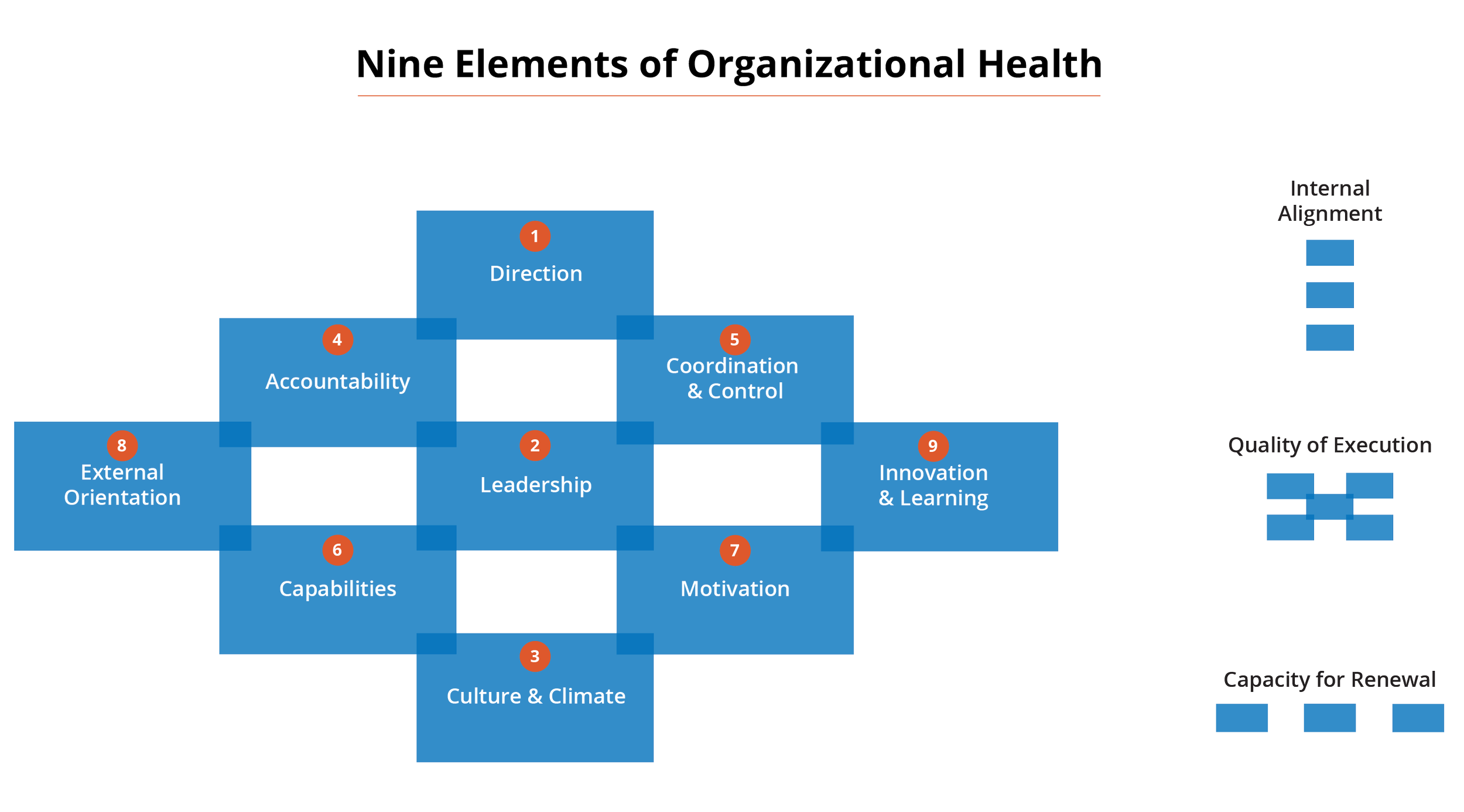
Figure 2. The nine elements of organizational health, illustrating how leadership, operational systems, and cultural factors combine to shape internal alignment, execution effectiveness, and an organization’s capacity for renewal.
An important note on methodology: the OHI is well-validated as a correlational tool. It strongly predicts financial performance. The causal mechanisms are supported by longitudinal evidence but are not established by controlled experiment—a limitation common to all large-scale organizational research. We use the OHI here as a diagnostic lens, not a causal model. The nine elements give us a rigorous, evidence-informed way to identify where operations are breaking down and where intervention is most likely to help.
To our knowledge, this framework has not been systematically applied to corporate legal departments—despite the fact that legal consistently ranks among the most operationally stressed functions in enterprise organizations. That gap is itself part of the problem this series addresses. The tools for diagnosis exist. They simply have not been brought to bear on the function that may need them most.
The nine elements group into three clusters. Each cluster maps directly to conditions that legal departments are struggling with right now.
Internal Alignment — Does the organization share objectives supported by its culture and meaningful to its people
1. Direction. A clear sense of where the organization is headed and how it will get there, meaningful to all team members. Red flag: if the lawyers on your team cannot articulate the department’s top three priorities in roughly the same way, you have a direction problem.
2. Leadership. The extent to which leaders inspire action by others. Red flag: if your team complies with directives but does not bring problems or ideas to leadership, you have compliance without commitment.
3. Culture & Climate. The shared beliefs and quality of interactions within and across organizational units. Red flag: if lessons from failures stay inside the team that experienced them, your culture rewards comfort over learning.
Quality of Execution — Does the organization have the capabilities, processes, and motivation to execute with excellence?
4. Accountability. The extent to which individuals understand what is expected of them, have sufficient authority to carry it out, and take responsibility for delivering results. Red flag: if work stalls because people are waiting for approvals they don’t technically need, your accountability structure is creating drag.
5. Coordination & Control. The ability to evaluate organizational performance and risk, and to address issues and opportunities when they arise. Red flag: if you cannot answer the question “what is our team actually spending its time on?” with data, you are managing by intuition.
6. Capabilities. The presence of the institutional skills and talent required to execute strategy and create competitive advantage. Red flag: if you are losing people faster than you can develop them, your capability base is eroding regardless of your hiring efforts.
7. Motivation. The presence of enthusiasm that drives employees to put in extraordinary effort to deliver results. Red flag: if your team is still productive but no one volunteers for stretch assignments or improvement projects, motivation has shifted from engagement to endurance.
Capacity for Renewal — Is the organization effective at understanding, interacting with, and adapting to its situation?
8. External Orientation. The quality of engagement with customers, suppliers, partners, and other external stakeholders to drive value. For legal departments, the “customers” are the internal business units the department serves. Red flag: if business leaders describe their experience with legal as “slow” or “disconnected from the business,” your external orientation needs work.
9. Innovation & Learning. The quality and flow of new ideas and the organization’s ability to adapt and shape itself as needed. Red flag: if “improving how we work” is treated as a separate initiative rather than an embedded part of the job, innovation is siloed and fragile.
These nine elements are not abstract. They map directly to the stages of the doom loop described in this paper—and that mapping is what makes them useful. A department overwhelmed by volume without strategic prioritization has a Direction problem. One whose processes are manual, chaotic, and reactive has a Coordination & Control problem. A team whose internal clients bypass it and whose reputation is declining has an External Orientation problem. A leadership structure that defaults to throughput metrics because the system above it demands them has Leadership and Accountability problems—not because the leaders are failing, but because the conditions for effective leadership are absent. And a department losing experienced professionals faster than it can develop or replace them is watching its Capabilities and Motivation erode in real time. The doom loop describes what is happening. The nine elements help you see where to intervene. The papers that follow will take each connection in turn.
| Doom Loop Stage | OHI Elements | The Question to Ask |
|---|---|---|
| Growing Volume | Direction, External Orientation | Are we clear about what we should and shouldn’t take on? |
| Insufficient Resources & Practices | Coordination & Control, Capabilities, Accountability | Can we see our own operations clearly enough to make informed resource decisions? |
| Lack of Technology Support | Capabilities, Innovation & Learning | Are we deploying tools that solve real workflow problems, or checking boxes? |
| Negative Internal Reputation | External Orientation, Culture & Climate | How do our internal clients actually experience working with us? |
| Increased Management Pressures | Leadership, Accountability, Coordination & Control | Are we leading with data and clear expectations, or managing by anxiety? |
| Burnout & Turnover | Motivation, Culture & Climate, Direction | Have we created conditions where good people can stay—or are we relying on their endurance? |
This paper was researched and written by Mike Tobias with drafting and editorial assistance from Claude, an AI assistant developed by Anthropic. All research, source evaluation, analytical judgments, and editorial decisions are the author’s. These are presented as working hypotheses, and we welcome constructive challenge.
About mot-r
This whitepaper is part of a series produced by mot-r, the Legal Operating Layer for in-house legal teams. The research in this series is independent, but it is not unrelated to what we build. The evidence-based frameworks, the organizational health principles, and the operational thinking described in these papers informed the original design of mot-r and continue to shape every subsequent improvement. We built the platform around this thinking because we believe it is right—and these papers exist so you can evaluate the thinking on its own merits, whether or not you ever use our product.To explore the ideas in this series further, visit the mot-r website at www.mot-r.com/resources, our blog at www.mot-r.com/main-blog and the Legal Ops Briefs series at www.mot-r.com/legal-ops-briefs-3-minute-reads.
What this mapping makes visible is that no stage of the doom loop is a single-element failure. Every stage involves at least two dimensions of organizational health, and several elements—Coordination & Control, Capabilities, Leadership—appear across multiple stages. This is why single-point interventions disappoint. A technology deployment that ignores the Capabilities gap it depends on, or a metrics overhaul that doesn’t address the Leadership conditions constraining it, is solving half a problem. The framework doesn’t just identify where to intervene—it reveals what each intervention needs to succeed.
The Evidence Standard
A diagnostic framework is only as useful as the quality of thinking applied to it. Throughout this series, we hold ourselves to the five principles of evidence-based management articulated by Jeffrey Pfeffer and Robert Sutton:
Face the hard facts, and build a culture in which people are encouraged to tell the truth, even when it is unpleasant.
Be committed to fact-based decision making—which means being committed to getting the best evidence and using it to guide actions.
Treat your organization as an unfinished prototype—encourage experimentation and learning by doing.
Look for the risks and drawbacks in what people recommend—even the best medicine has side effects.
Avoid basing decisions on untested but strongly held beliefs, what you have done in the past, or on uncritical benchmarking of what winners do.
Concretely, this means: when we cite a study, we will note its methodology and limitations. When we recommend a practice, we will distinguish between what the evidence supports and what it does not. And when the honest answer is we don’t know yet, we will say that. This is not an academic exercise. It is a practical commitment to not wasting your time with recommendations we cannot substantiate.
The point of this framework is not to add another layer of assessment on top of already overloaded teams. It is to give leaders a clear, validated way to see what is actually happening—because you cannot address conditions you cannot see. And the nine elements, paired with the evidence-based management commitment, offer something most improvement initiatives lack: a way to distinguish between interventions that address root causes and those that merely suppress symptoms.
The Path Forward
The doom loop is not inevitable. It is a reinforcing cycle—and reinforcing cycles, once understood, can be interrupted.
This paper has been diagnostic—it has mapped the cycle and introduced the framework for seeing it clearly. The evidence that these conditions can be changed is the subject of the papers that follow. But the foundation is this: when the elements identified above are addressed with evidence-based discipline, the reinforcing logic of the loop can be broken. Not all at once, and not overnight. But deliberately, measurably, and in ways that respect both the complexity of the problem and the capacity of the people doing the work.
Where This Series Goes Next
The detailed guidance begins in the next paper. But you do not need to wait for it to begin. If you take one thing from this paper, let it be this: the single most diagnostic act a legal department leader can perform is to ask the people doing the work what makes them unproductive—and then listen without defending. The doom loop and the nine elements give you the map. The exercise below helps you find where you are standing on it.
Find Your Entry Point
Ask five people on your team, individually and privately:
What is the single biggest obstacle to doing your best work?
What task do you spend time on that you believe adds no value?
If you could change one thing about how this department operates, what would it be?
Do not argue with the answers. Do not explain why things are the way they are. Just record what you hear. If the same themes appear across three or more conversations, you have found the entry point of your particular doom loop.
This exercise costs nothing, requires no budget approval, and can be done this week. It is also, in our experience, the step most often skipped—not because leaders do not care, but because the operational pressures of the loop leave little room for the kind of open-ended inquiry that surfaces root causes. Making that room, even briefly, is itself an act of leadership.
This paper has established the foundation: the human cost, the structural cycle that produces it, why conventional responses have not worked, and the diagnostic framework that makes it possible to see the system clearly. We recognize that seeing clearly is necessary but not sufficient—most general counsel operate within political realities that constrain their ability to act even when they understand what needs to change. The papers that follow will address not only what to change but how to build that case in the financial and risk language that CFOs, boards, and executive committees require.
The papers that follow will take each stage of the doom loop in turn—examining it through the lens of organizational health and evidence-based management, drawing on the best available research and the practical realities of corporate legal operations. Each paper will include specific diagnostic questions, evidence-based guidance, and concrete starting points for general counsel and legal operations leaders who want to interrupt the cycle in their own departments.
The next paper will address growing volume and scope of work—the entry point of the cycle—and examine what it means for a legal department to have genuine strategic direction rather than simply absorbing whatever work arrives. The following paper will examine insufficient resources and operating practices, including the question of why departments that know they are operationally immature struggle to improve. Subsequent papers will address technology deployment, internal reputation, management pressures, and the burnout and turnover that close the loop.
Shorter-form articles will address the specific sources of tension that legal teams report—communication breakdowns, technology adoption challenges, misaligned priorities, metric problems, resource allocation, and role ambiguity—with the same evidence standard applied to each.
Throughout, we will maintain the commitment stated in this paper. We will be transparent about what the evidence says and where it is silent. We will be rigorous about the distinction between correlation and causation. We will not recommend practices we cannot support with data. We will not offer platitudes about “transformation” without explaining what, specifically, needs to change and how to tell whether it worked. And we will remain focused on the people at the center of this work—the professionals who chose this career and deserve operating conditions that allow them to practice it well, and the leaders who are trying to provide those conditions within systems that have not made it easy.
The people in your legal department are doing the best they can within systems that were not designed to support them. They did not create the doom loop. Neither did you. Everyone inside it—the team members, the managers, and the leaders—is responding rationally to the conditions they can see. The problem is that the full cycle is only visible when you step outside it. That is what this series is designed to help you do.
This series is about changing the conditions.
Sources and Methodology Notes
The following sources are cited in this paper. We have noted the methodology and any limitations for each, consistent with our evidence-based management commitment.
Primary Sources (Large-scale research, validated methodology)
Association of Corporate Counsel. “The State of Stress Among In-house Legal Professionals.” December 2025. Survey of 1,600 U.S.-based in-house professionals using a validated five-point stress scale. Conducted by the premier industry association with no commercial product interest in the findings.
Association of Corporate Counsel and FTI Consulting. “2025 ACC Chief Legal Officers Survey.” January 2025. Twenty-sixth annual edition surveying 772 CLOs across 20 industries and 48 countries.
Provides data on litigation volume trends, investigation increases, expanding CLO scope (compliance, risk management, ESG oversight), and resource constraints. Used here for evidence on the specific drivers of growing workload in legal departments.
CLOC and HBR Consulting. “2025 State of the Industry Report.” Twenty-first annual edition, based on the 2024 Harbor Law Department Survey in collaboration with CLOC. 186 organizations across 15+ industries and 14 countries. Established methodology with longitudinal comparability. CLOC is a non-profit industry consortium; Harbor (formerly HBR Consulting) conducted the underlying survey.
EY Law and Harvard Law School Center on the Legal Profession. “General Counsel Imperative Series.” Research initiative based on interviews with more than 2,000 business leaders from 17 industries and 22 countries, conducted in January 2021. The first report, “How do you turn barriers into building blocks?”, draws on 1,000 interviews with General Counsel specifically. EY is a professional services firm with commercial interests in legal managed services; the Harvard Law School Center on the Legal Profession is an academic institution. Figures cited in this paper: 76% find it challenging to manage current workloads; 75% don’t expect budgets to keep pace; one in five in-house counsel hours spent on low-complexity repetitive tasks; 87% confirm too much time on routine work; 47% report that increasing volumes of low-complexity work have adversely impacted employee morale. Note: data is from January 2021—now nearly five years old. Still widely cited in the industry, and more recent surveys (CLOC 2025, ACC 2025) confirm conditions have worsened, so these findings likely understate current reality.
Gallup. “This Fixable Problem Costs U.S. Businesses $1 Trillion.” March 2019. By Shane McFeely and Ben Wigert. Estimates employee replacement cost at one-half to two times annual salary, based on Gallup’s aggregation of workplace research. This is a general-workforce estimate, not specific to legal departments; we apply it to legal compensation data to construct a directional range, not a precise figure.
ACC and Empsight International. “2025 Law Department Compensation Survey Executive Summary.” September 2025. Survey of 1,637 U.S.-based in-house legal professionals covering base salary, bonuses, and long-term incentives across all job categories and company revenue sizes. Used here for compensation benchmarks applied to the Gallup turnover cost multiplier.
Deming, W. Edwards. “A bad system will beat a good person every time.” Four Day Deming Seminar, Phoenix, Arizona, February 1993. Sourced via the notes of Mike Stoecklein, as documented by The
W. Edwards Deming Institute.
McKinsey & Company. Organizational Health Index research (2003–2024). More than 8 million survey respondents across 2,600+ organizations. OHI is correlational, not causal; used here as a diagnostic framework, not a predictive model.
Pfeffer, Jeffrey, and Robert I. Sutton. “Evidence-Based Management.” Harvard Business Review, January 2006. Also: Hard Facts, Dangerous Half-Truths and Total Nonsense. Harvard Business School Press, 2006.
Richard, Larry, Jeff Foster, Lisa Rohrer, and Mark Sirkin. “Understanding Lawyers: Why We Do the Things We Do.” Hogan Assessment Systems and Hildebrandt Baker Robbins, 2010. Personality assessment of nearly 2,000 lawyers across four large firms using the Hogan Personality Inventory (HPI), Hogan Development Survey (HDS), and Motives, Values, Preferences Inventory (MVPI), compared against 4,800+ managers and professionals in industry. Found lawyers score highest on “Moving Away” stress responses (Excitable, Skeptical, Cautious, Leisurely, Reserved)—all at the 62nd–68th percentile—in “marked contrast” to other managers who elevate on “Moving Against” attributes. Dr. Larry Richard, the study’s lead researcher, has profiled more than 25,000 lawyers over 30 years. His earlier Caliper-based research (“Herding Cats: The Lawyer Personality Revealed,” Managing Partner Forum) found Skepticism consistently averaging around the 90th percentile in large firms, Autonomy at the 89th percentile, and Resilience below the 50th percentile for 90% of lawyers. Richard’s characterization of lawyers as “thin-skinned” and his explanation of risk aversion as a function of skepticism, autonomy, and sensitivity to criticism are drawn from his 2023 interview published by Ogletree Deakins and his 2025 Heidrick & Struggles Leadership Podcast appearance.
Richard is a former trial attorney who holds a Ph.D. in Psychology from Temple University; he is a consultant with commercial interests in lawyer development programs.
Drucker, Peter F. “Knowledge-Worker Productivity: The Biggest Challenge.” California Management Review 41, no. 2 (1999). Foundational framework for understanding knowledge-worker productivity.
Ford Motor Company historical data. In 1913, Ford’s Highland Park plant had a labor turnover rate of approximately 370%, requiring the company to hire over 50,000 workers to maintain a workforce of roughly 14,000. Figures drawn from multiple historical sources including The Henry Ford museum archives and EBSCO Research Starters. Ford’s response—the $5 day in January 1914—is used here as an analogy, not a direct comparison to knowledge-worker conditions.
Thomson Reuters Institute. “2024 State of the Corporate Law Department.” Based on more than 4,500 interviews and surveys with C-level executives, General Counsels, in-house legal teams, and corporate legal operations and risk and compliance professionals. Found 69% of in-house lawyers feel moderate to significant budgetary pressure from business leaders; 72% focused on building efficient in-house workflows. Identifies a gap between the value legal aims to provide and how it is perceived by business leadership. Robust methodology with global scope.
Association of Corporate Counsel. “2024 ACC Chief Legal Officers Survey.” Twenty-fifth annual edition surveying 669 CLOs across multiple industries. Found 42% of legal departments received a cost-cutting mandate in the previous year; 59% of CLOs reported increased workload; 58% experienced major rate hikes from outside firms. Also documented declining CLO access to organizational leadership: board meeting attendance dropped from 82% to 76% year-over-year (first decline in several years); regular meetings with business leaders on operational issues and risk fell from 76% (2020) to 64% (2024); CLOs regularly sought out for strategic business input dropped from 73% (2020) to 48% (2024). Declining-access analysis drawn from Michael W. Peregrine, “The Governance Relevance of the ACC Chief Legal Officers Survey,” published in NACD Directorship Magazine, March 2024. Methodology consistent with the 2025 edition cited above.
World Health Organization. Burnout definition, ICD-11 (2019). Classifies burnout as an occupational phenomenon resulting from chronic workplace stress that has not been successfully managed.
Industry Surveys (Well-designed, some commercial interest)
Axiom. “View from the Inside” survey series: 1st Annual (2022), 2nd Annual (2023), U.S. Survey (2024). Conducted by Wakefield Research (independent research firm). Respondents are in-house lawyers across company sizes and industries. Axiom is a major alternative legal services provider with commercial interests in the space; methodology is sound and independently administered.
ContractWorks (Onit). “2022 In-house Legal Tech Report.” Survey of 350 in-house legal professionals (250 US, 100 UK) conducted by Censuswide, an independent research firm. Found 77% of respondents had experienced at least one failed technology implementation; 43% had experienced more than one. Primary failure factors: lengthy implementation (38%), overcomplicated solutions (36%), technology unfit for actual needs (33%). ContractWorks is a legal technology vendor (subsidiary of Onit); survey was independently administered.
Onit. “2023 Enterprise Legal Reputation (ELR) Report.” Annual multinational study of 4,000 non-legal enterprise employees and 500 corporate legal professionals across the U.S., U.K., France, and Germany. Conducted by Provoke Insights (independent, New York City-based market research firm) in November 2022 and commissioned by Onit. Examines year-over-year perceptions of legal’s brand image, responsiveness, and efficiency through the eyes of internal business clients. Key findings include: only 27% of enterprise employees consider legal a good business partner; 67% bypass legal and its policies; 71% report response times of days or weeks; relationships with legal declined year over year in every department surveyed. Onit is a legal workflow solutions vendor; commercial interest acknowledged, but the study’s scale, independent administration, and specificity make it the most comprehensive data available on how business units actually experience working with legal departments.
Axiom. “2025 In-House Legal Budgeting Report.” September 2024. Survey of 200 GCs and CLOs from U.S. companies with minimum annual revenue of $250 million, conducted by Wakefield Research (independent). Found 77% of GCs have experienced tension with their CFO, primarily over conflicting priorities between cost-cutting and risk management; 37% measured on outside counsel spend; 49% report good CFO relationship. Axiom is an alternative legal services provider with commercial interest; methodology is sound and independently administered.
Axiom. “2026 Legal Budgeting Report: In-House Legal’s Journey to Value.” September 2025. Global study of 530 senior legal decision-makers (CLOs, GCs, DGCs) and CFOs from companies with $500M+ annual revenue, conducted by The Harris Poll (independent) in July 2025. Incorporates both legal and finance perspectives. Found that despite 89% rating the GC-CFO relationship as excellent, 50% of CFOs say they control budget-setting while only 32% of legal leaders agree—revealing structural confusion over budget authority. Also found 78% expected to implement legal AI without dedicated funding. Axiom is an alternative legal services provider with commercial interest; methodology is sound and independently administered at larger scale than the 2025 edition.
Axiom. “2026 Global In-House Talent Study.” Published 2025. Survey of 530 senior legal decision-makers conducted by The Harris Poll (independent) in July 2025. Found 46% of in-house legal professionals are actively job searching, including those who report being satisfied and fairly compensated. Also found that legal departments partnering with ALSPs report only 14% of team members actively job hunting compared to 28% without ALSP support. Axiom is an alternative legal services provider with commercial interest in ALSP adoption; methodology is sound and independently administered.
Axiom. “2024 In-House Report.” November 2024. Third annual edition. National survey of 300 in-house legal professionals conducted by Wakefield Research (independent). Found 58% considering leaving current positions; 70% say they will need to switch employers to advance their careers. Axiom is an alternative legal services provider with commercial interest; methodology is sound and independently administered.
Axiom. “View from the Top: GCs’ 2024 Outlook on Budgets, Talent, and Innovation.” April 2024. National study of 300 GCs at companies ranging from small/mid-sized businesses to large enterprises, conducted by Wakefield Research (independent). Found 81% of GCs say teams lack in-house staffing for required tasks; 80% face headcount freeze in next 12 months; nearly 40% of outsourced work could have been handled internally if time and staffing allowed; 96% had budgets cut coming into 2024; 87% concerned about ability to invest in necessary talent. Axiom is an alternative legal services provider with commercial interest; methodology is sound and independently administered.
U.S. Bureau of Labor Statistics. Lawyer unemployment rate of 0.9% during Q1 2025, and paralegal/legal assistant unemployment rate of 1.9%, both well below the national rate of 4.2% as of May 2025. Cited via Robert Half, “2025 In-Demand Legal Roles and Hiring Trends,” June 2025.
Davis, Paula. “How Teams Can Help Address Burnout in the Legal Profession.” National Association for Law Placement. Argues for systemic rather than individual approaches to burnout.
This paper was prepared with a commitment to source transparency. Where data is directional rather than definitive, we have said so. Where survey respondents reflect perceptions rather than objective measurements, we have noted it. We encourage readers to examine the underlying sources and draw their own conclusions.